Product Overview
In conventional industrial cleaning processes, DI water is commonly used for the final rinsing stage. Depending on the cleaning machine and production rate, this can generate a significant volume of rinse wastewater.
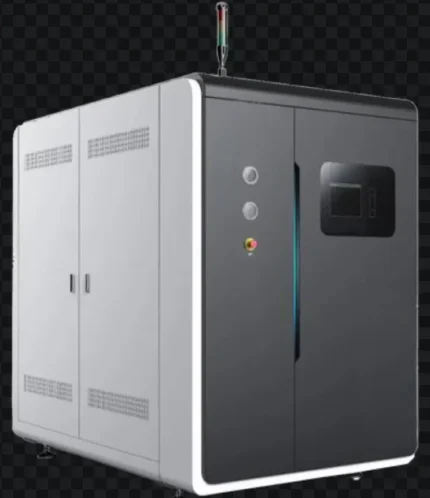
The T-400 wastewater distillation system provides an alternative treatment route by recovering water from the rinse wastewater through evaporation and condensation.
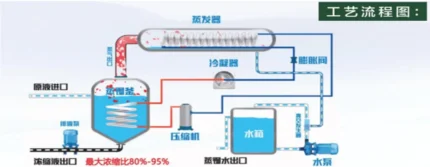
The wastewater is continuously fed into the evaporation tank. Under controlled heating, water is converted into vapor and then condensed through the 316L stainless steel water-cooled heat exchanger. Non-volatile contaminants remain concentrated in the evaporation tank and can be discharged through the bottom residue outlet.
The system supports continuous feeding, continuous discharge, automatic feeding, stirring and liquid-level control, reducing the need for frequent manual operation.
For industrial cleaning applications, the T-400 can be integrated with a rinse wastewater collection and recovery system to reduce the volume of wastewater requiring external treatment.
Key Features
1. Continuous Rinse Wastewater Recovery
The T-400 supports continuous feeding and continuous discharge, allowing the system to operate for extended periods without requiring a complete tank refill between cycles.
The automatic feeding system monitors the liquid level and supplies wastewater according to the operating condition.
Recovery capacity: approximately 25–35 L/h of water.
2. Designed for Approximately 500 L/Day Wastewater Treatment
The operating time can be set between 10 and 16 hours, providing sufficient operating time to process approximately 500 L of rinse wastewater per day, depending on wastewater characteristics and actual operating conditions.
This makes the T-400 suitable for cleaning lines where rinse wastewater is generated continuously during production.
3. 316L Stainless Steel Evaporation Tank
The evaporation tank is manufactured from SUS316L stainless steel with a wall thickness of approximately 4 mm.
316L stainless steel provides good resistance to corrosion and is suitable for industrial wastewater applications involving chemical cleaning residues.
The tank is equipped with a bottom residue outlet for convenient removal of concentrated solids.
4. Water Recovery Through Distillation
The T-400 uses a thermal evaporation and condensation process:
Rinse Wastewater → Heating & Evaporation → Vapor Condensation → Recovered Water
Non-volatile contaminants and concentrated solids remain in the evaporation tank and are collected for appropriate waste disposal.
The system is designed to distill the incoming rinse wastewater and recover the water fraction. Actual recovered-water quality depends on the composition of the wastewater and should be verified for the intended reuse application.
5. Six-Stage Temperature Control
The heating temperature can be controlled in up to six stages, with temperature control accuracy of approximately ±1°C.
A silicon-controlled rectifier (SCR) heating system provides continuous and adjustable heating rather than simple intermittent ON/OFF heating, allowing the operating temperature to be controlled more precisely.
6. Dual Temperature Protection
The system uses two independent electronic temperature-control systems:
- Omron temperature controller
- Secondary temperature controller
- Independent temperature alarm
- Over-temperature protection
If the primary temperature controller fails, the secondary temperature-control system can provide additional protection and trigger an alarm.
7. Multi-Level Pressure Safety Protection
The T-400 incorporates multiple pressure protection measures.
When internal pressure exceeds approximately 0.04 MPa, the system stops heating and triggers an alarm.
An additional 1-inch stainless steel safety valve provides a dedicated pressure-relief path to help release pressure smoothly.
The pressure-rated tank cover is designed so that pressure can be safely relieved through the safety system rather than causing excessive stress on the sealing gasket.
8. Automatic Feeding System
The pneumatic feeding system consists of:
- Pneumatic pump
- Pneumatic ball valve
- Solenoid valve
- Liquid-level controller
- PLC control system
Automatic liquid-level control helps maintain the appropriate operating level inside the evaporation tank.
9. Automatic Stirring & Level Control
The T-400 incorporates a stirring function to improve liquid circulation during evaporation.
High- and low-level sensors monitor the tank condition and work together with the automatic feeding system to maintain stable operation.
10. PTFE Sealing System
The tank sealing gasket is custom-molded from pure PTFE (polytetrafluoroethylene).
The integrated sealing design provides good chemical resistance and sealing performance. Under normal operating conditions, the gasket is designed for a service life of more than three years, depending on wastewater chemistry, temperature and operating conditions.
11. Visual Inspection Window
A viewing window with integrated lighting allows operators to observe the distillation condition inside the tank without opening the equipment.
This makes it easier to monitor the evaporation process and check the condition of the remaining concentrate.
12. PLC Control with Chinese & English Interface
The T-400 uses PLC-based control with a bilingual Chinese/English display interface.
The control system can display operating conditions and alarm information, while abnormal conditions or component failures can trigger corresponding warning messages.
External control adjustment and independent password protection help reduce the risk of incorrect operation.
13. Multiple Automatic Protection Functions
The system incorporates several protection functions, including:
- Over-temperature protection
- Over-pressure protection
- Timed shutdown
- Temperature-based shutdown
- Dry-run protection / anti-dry-run function
- Low-water protection for the cooling-water system
- Alarm indication
These functions are designed to improve operational safety during unattended or extended operation.
14. 316L Stainless Steel Water-Cooled Condenser
The condensation system uses a 316L stainless steel water-cooled heat exchanger.
The material provides good corrosion resistance for industrial applications and is suitable for environments where the wastewater may contain acidic or alkaline residues.
A circulating cooling-water supply and return line are required at the installation site.
Typical Process
Rinse Wastewater Collection → Automatic Feeding → Heating & Stirring → Controlled Evaporation → Water Vapor Condensation → Recovered Water Collection → Concentrated Residue Discharge
The distillation process separates the water fraction from non-volatile contaminants. The concentrated residue is retained in the evaporation tank and removed through the bottom discharge outlet.
Typical Applications
The T-400 is designed for industrial rinse wastewater recovery, particularly where cleaning equipment generates relatively high volumes of rinse water.
Electronics & PCBA Cleaning
Suitable for wastewater generated during:
- PCBA cleaning
- Flux removal
- SMT cleaning
- Stencil cleaning
- Fixture and pallet cleaning
- Precision electronic component cleaning
Semiconductor Cleaning
Potential applications include:
- Semiconductor packaging cleaning
- BGA / FCBGA cleaning
- FCCSP cleaning
- SiP cleaning
- Leadframe cleaning
- Power semiconductor cleaning
- IGBT cleaning
Integration with ACTSPRAY Cleaning Systems
The T-400 can be used as part of a wastewater recovery solution for ACTSPRAY industrial cleaning equipment.
A typical system can be configured as:
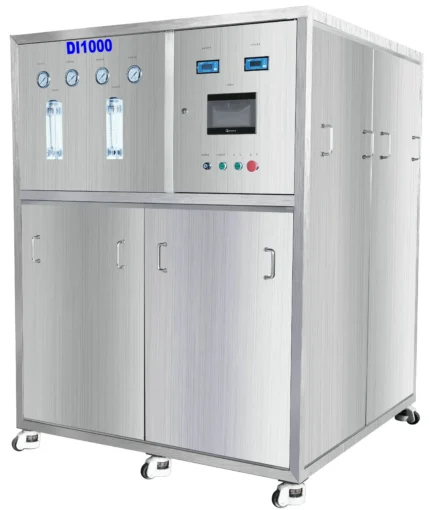
DI Water Generator (e.g. DI200) ←
↓ |
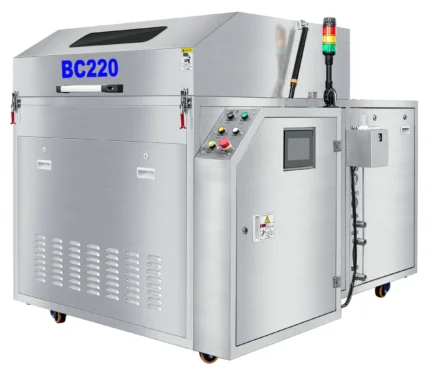
PCBA Cleaning Machine (e.g. AC530) |
↓ | (Wastewater Treatment / Reuse)
T-400 Distillation System ↑
The final system configuration should be selected according to the cleaning chemistry, wastewater composition, production capacity and required recovered-water quality.
Technical Specifications
| Item | Specification |
|---|---|
| Equipment Type | Rinse Wastewater Distillation & Recovery System |
| Model | T-400 |
| Feed Capacity | 250–300 L |
| Total Tank Capacity | 460 L |
| Water Recovery Rate | Approx. 25–35 L/h |
| Typical Daily Treatment | Approx. 500 L/day |
| Operating Time | 10–16 h/day |
| Tank Material | SUS316L Stainless Steel |
| Tank Thickness | Approx. 4 mm |
| Residue Discharge | Bottom discharge port |
| Feeding Method | Automatic / pneumatic feeding |
| Discharge Method | Pneumatic or manual |
| Stirring | Integrated |
| Liquid-Level Control | High / low level control |
| Temperature Control | Up to 6 stages |
| Temperature Accuracy | Approx. ±1°C |
| Heating Method | SCR-controlled electric heating |
| Heating Power | 24 kW |
| Additional Power | 2 kW |
| Heater Configuration | 6 kW × 4 groups |
| Power Supply | 380 V |
| Control System | PLC |
| Display | Chinese / English |
| Temperature Protection | Dual electronic temperature control |
| Pressure Protection | Automatic heating shutdown + alarm |
| Safety Valve | 1-inch stainless steel safety valve |
| Pressure Protection Set Point | Approx. 0.04 MPa |
| Sealing Material | Pure PTFE |
| Condenser Material | SUS316L |
| Cooling Method | Water-cooled |
| Cooling Water | Circulating cooling water required |
| Visual Inspection | Illuminated viewing window |
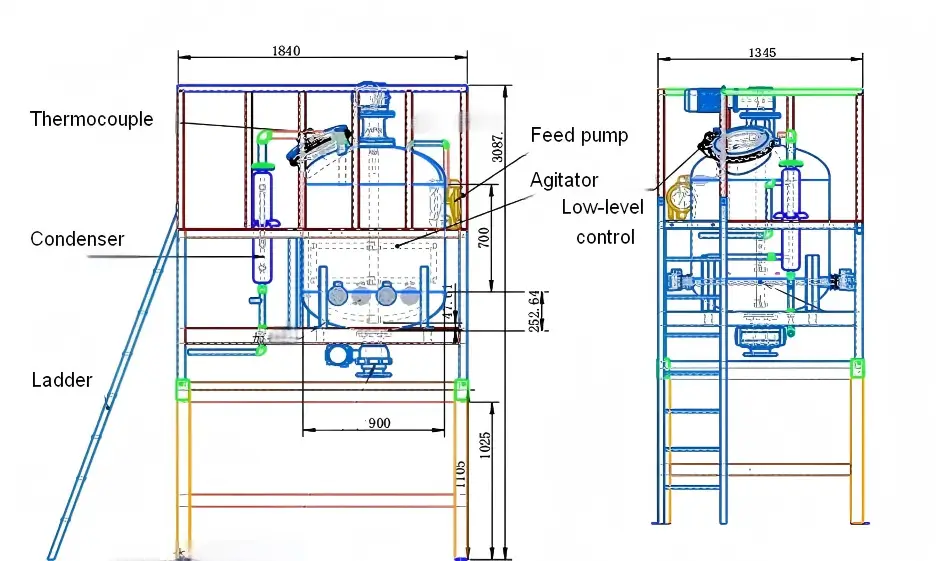
| Dimensions | Approx. (1840 + 1250) × 1345 × 2530 mm |
| Net Weight | Approx. 900 kg |
Note: Actual wastewater recovery rate depends on wastewater composition, operating temperature, cooling-water conditions and other process parameters. Final equipment configuration should be confirmed based on the customer’s wastewater characteristics.
Safety & Control Functions
The T-400 is equipped with multiple control and protection functions for industrial operation:
Temperature Protection
Prevents excessive heating and provides alarm/shutdown functions.
Pressure Protection
Stops heating when pressure exceeds the specified protection threshold and activates the safety valve system.
Level Protection
High- and low-level monitoring controls automatic feeding and helps prevent abnormal operating conditions.
Dry-Run Protection
The system can be configured with dry-run / anti-dry-run protection according to the application.
Timed Shutdown
Operating time can be preset to automatically stop the equipment after the selected operating period.
Password Protection
Independent password locking helps prevent unauthorized changes to operating parameters.
Why Use Wastewater Distillation for Rinse Water Recovery?
Traditional rinse processes often use DI water continuously, resulting in a large volume of wastewater that requires collection and treatment.
A wastewater distillation system provides a way to recover the water fraction through evaporation and condensation while concentrating non-volatile contaminants into a smaller residue stream.
For high-volume cleaning operations, this can help:
- Reduce the volume of wastewater requiring external treatment
- Recover water from rinse wastewater
- Reduce wastewater transportation and disposal requirements
- Concentrate non-volatile contaminants for easier handling
- Support closed-loop or reduced-wastewater cleaning strategies
- Improve overall wastewater management for industrial cleaning lines
The actual economic and environmental benefits depend on wastewater volume, composition, local disposal requirements and the final reuse strategy.