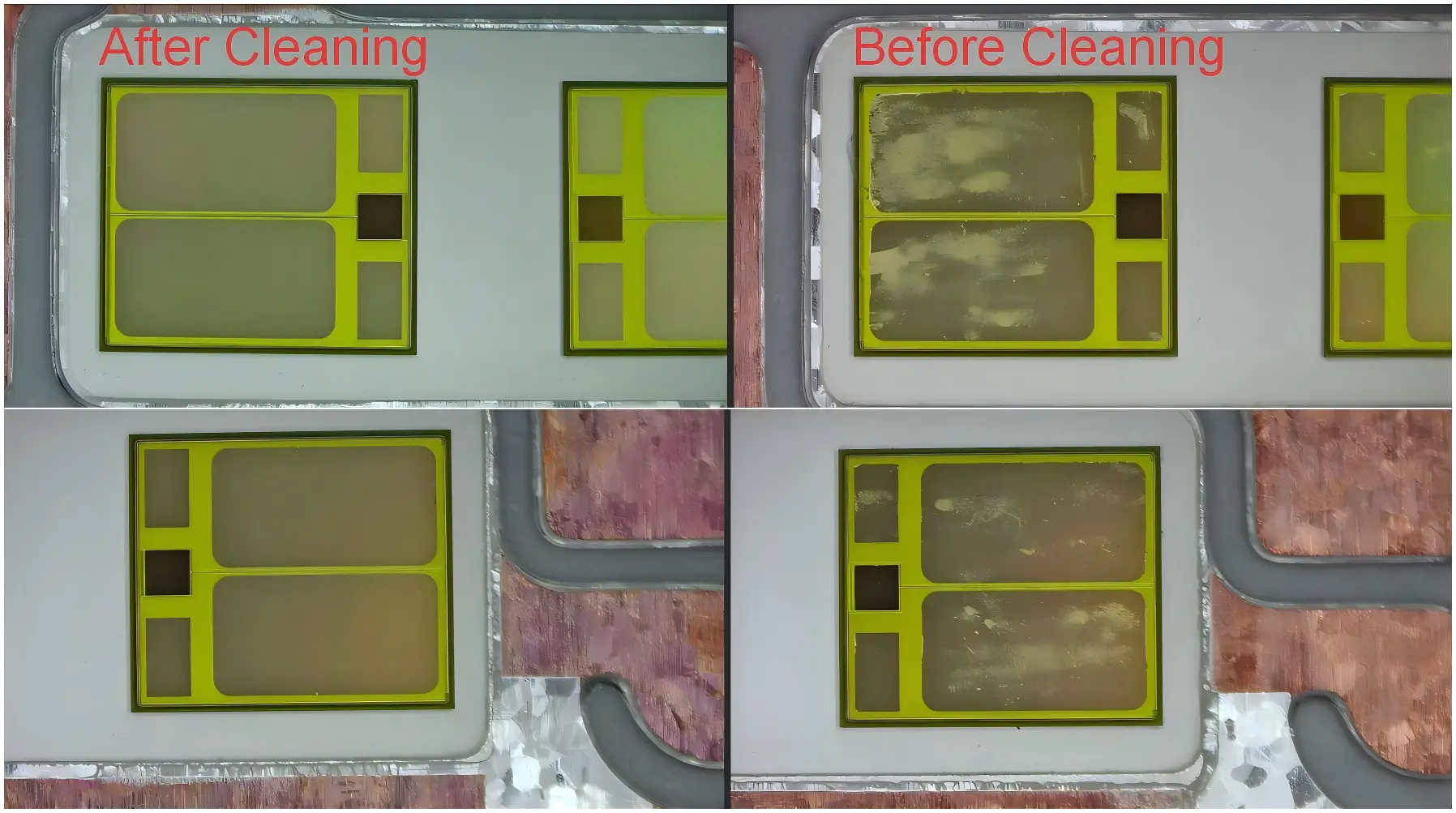
Customer Application
A power semiconductor manufacturer approached ACTSPRAY to evaluate the cleaning of IGBT components after the soldering process.
The main objective was to remove flux residues from the IGBT surface before the subsequent wire bonding process, while maintaining the original condition of the copper surface.
The Cleaning Challenge
IGBT cleaning presents different requirements from conventional PCBA cleaning.
After soldering, flux residues may remain on the component surface. These residues need to be removed before wire bonding to provide a clean and stable bonding surface.
At the same time, the copper surface must be carefully protected during cleaning. An unsuitable cleaning process may cause copper discoloration or affect the surface condition, which can create additional concerns for downstream bonding processes.
Therefore, the cleaning process needed to achieve two objectives:
- Effective removal of flux residues
- Protection of the copper surface against discoloration
Why Clean IGBT Before Wire Bonding?
Wire bonding requires a clean and stable bonding surface to establish consistent electrical and mechanical connections.
Flux residues and other process contaminants remaining on the IGBT surface may interfere with the bonding interface and potentially affect bonding consistency and long-term reliability.
Pre-bond cleaning can therefore help remove process residues before wire bonding and provide a more controlled surface condition for the subsequent manufacturing process.
For power semiconductor applications, however, cleaning cannot be considered independently from material compatibility. The process must remove contamination without negatively affecting the copper surface or other sensitive areas of the component.
Cleaning Process
ACTSPRAY conducted the trial using the FC760 Inline Cleaning Machine, with the operating parameters manually adjusted according to the IGBT application.
Test Parameters
| Process | Chain Speed | Spray Pressure |
|---|---|---|
| Cleaning | 10 cm/min | 2 kgf/cm² |
| Rinsing | 100 cm/min | 2 kgf/cm² |
| Drying | 100 cm/min | 2 kgf/cm² |
The relatively slower chain speed during cleaning provided sufficient cleaning exposure, while the rinsing and drying stages were operated at a higher speed.
Test Results
The cleaning trial achieved approximately 90% removal of the target flux residues.
The remaining approximately 10% of visible residue was identified as solder spatter generated during the customer’s upstream soldering process, rather than residual flux.
This distinction is important when evaluating the cleaning process. The solder spatter was related to the preceding soldering process and therefore requires optimization of the upstream process rather than simply increasing the cleaning intensity.
More importantly, the cleaning trial demonstrated that the selected process could effectively remove the majority of the target flux residues while maintaining the required condition of the copper surface.
Key Considerations for IGBT Cleaning
This application demonstrates that IGBT cleaning requires more than simply maximizing cleaning power.
A suitable process should balance:
Flux Residue Removal
Effectively remove residues generated during soldering.
Copper Surface Protection
Prevent discoloration or undesirable changes to the copper surface.
Wire Bonding Requirements
Provide a clean and stable surface for the subsequent bonding process.
Upstream Process Control
Distinguish cleaning-related residues from defects or contamination generated during soldering.
ACTSPRAY Solution
The FC760 Inline Cleaning Machine provides controlled spray cleaning, rinsing, and drying in a continuous process. For this IGBT application, ACTSPRAY manually adjusted the conveyor speed and spray pressure to match the customer’s cleaning requirements.
The trial confirmed the feasibility of using the FC760 for IGBT flux residue removal while maintaining copper surface protection.
For power semiconductor manufacturers, ACTSPRAY can conduct application testing using actual components and optimize the cleaning process based on contamination type, component structure, surface material, and downstream process requirements.
Conclusion
IGBT cleaning before wire bonding requires a carefully balanced process.
The goal is not only to remove flux residues, but also to protect the copper surface and provide a suitable condition for subsequent wire bonding.
In this trial, the ACTSPRAY FC760 achieved approximately 90% removal of the target flux residues, while the remaining contamination was identified as solder spatter associated with the upstream soldering process.
This case highlights the importance of developing a cleaning process based on the actual component, contamination, and complete manufacturing sequence rather than relying on cleaning parameters alone.
Have IGBT or power semiconductor components that require cleaning evaluation? ACTSPRAY can test your actual parts and help develop a suitable cleaning process.