September 7, 2026 | #Customer Visit
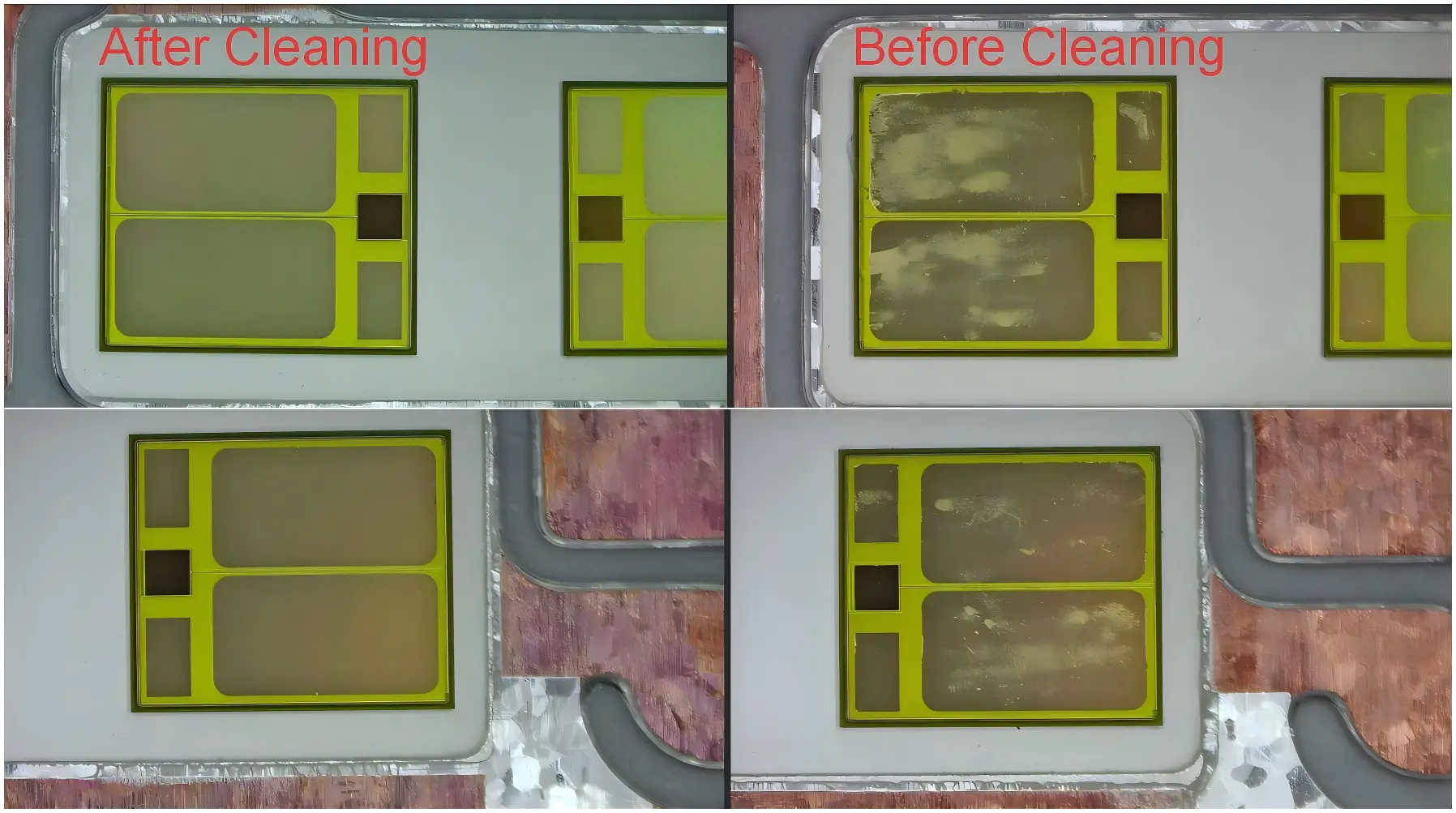
Today, ACTSPRAY welcomed a customer from the power semiconductor industry for an IGBT cleaning trial. The customer brought actual IGBT components to evaluate the removal of flux residues after the soldering process.
IGBT cleaning presents a particular challenge. The cleaning process must effectively remove flux residues while also protecting the copper surface from discoloration. Cleaning performance alone is not sufficient; maintaining the appearance and surface condition of the copper is also an important part of the process evaluation.
IGBT Cleaning Test with FC760
For this trial, ACTSPRAY used the FC760 Inline Cleaning Machine with the machine parameters manually adjusted according to the customer’s application requirements.
The test parameters were:
- Cleaning: Chain speed 10 cm/min, spray pressure 2 kgf/cm²
- Rinsing: Chain speed 100 cm/min, spray pressure 2 kgf/cm²
- Drying: Chain speed 100 cm/min, spray pressure 2 kgf/cm²
The test achieved approximately 90% removal of the target flux residues.
The remaining approximately 10% of the visible residue was identified as solder spatter generated during the customer’s upstream soldering process, rather than residual flux. This type of solder spatter is related to the preceding process and requires optimization of the soldering process itself rather than further adjustment of the cleaning process.
Cleaning Performance and Copper Protection
For IGBT applications, an effective cleaning process needs to achieve two objectives simultaneously:
1. Remove flux residues effectively
Flux residues remaining after soldering can affect the cleanliness and reliability of power semiconductor components.
2. Prevent copper discoloration
Aggressive or unsuitable cleaning conditions may affect copper surfaces. Therefore, cleaning performance must be evaluated together with the condition of the copper after cleaning.
During this trial, the FC760 cleaning process successfully removed the majority of the target flux residues while maintaining the required copper surface appearance.
Application-Based Cleaning Evaluation
This trial demonstrates the importance of evaluating power semiconductor cleaning using actual components and real process conditions.
For IGBT and other power semiconductor applications, ACTSPRAY engineers can adjust cleaning parameters such as conveyor speed and spray pressure according to the component structure, contamination characteristics, and surface protection requirements.
The final cleaning process should be developed by considering not only residue removal, but also the upstream manufacturing process and the required condition of the cleaned component.
Have IGBT or power semiconductor components that require cleaning evaluation? Contact ACTSPRAY to arrange a cleaning trial with your actual parts.
Why Clean IGBTs Before Wire Bonding?
Cleaning the IGBT before the wire bonding process is important for achieving a stable and reliable bonding interface.
After die attach and soldering processes, flux residues, organic contaminants, and other process residues may remain on the IGBT surface. If these contaminants are not properly removed before wire bonding, they may interfere with the bonding interface and affect bonding consistency and long-term reliability.
For power semiconductor applications, the cleanliness of the bonding surface is particularly important because the wire bonding process requires a clean and stable metal surface to achieve consistent electrical and mechanical connections.
Pre-bond cleaning can help:
- Remove flux residues and organic contaminants from the bonding area
- Reduce the risk of contamination affecting wire bonding
- Improve bonding process consistency
- Help maintain a clean and stable bonding surface
- Support long-term reliability of the IGBT package
However, IGBT cleaning requires careful process control. The cleaning process must remove contaminants effectively without causing copper discoloration, surface damage, or other changes to the bonding surface.
This is why cleaning performance and material compatibility should be evaluated together when developing an IGBT cleaning process before wire bonding.