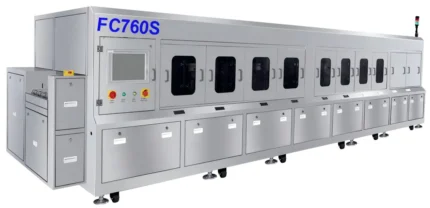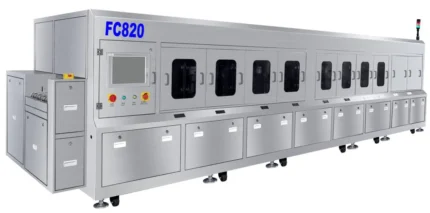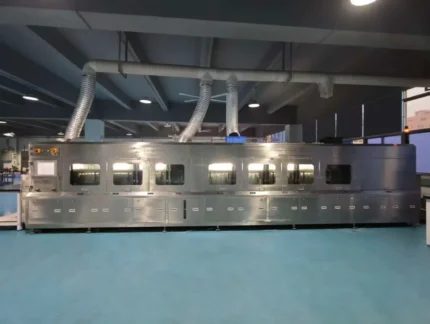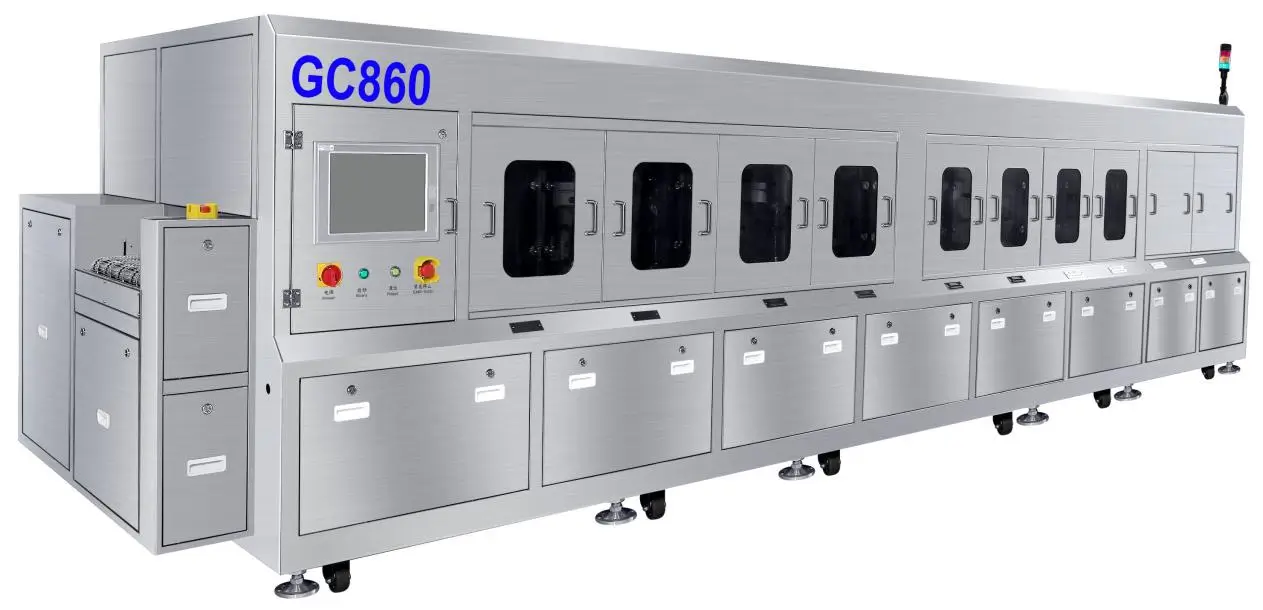
GC860 SIP Inline Zero Wastewater Cleaning Machine
Zero-Wastewater Inline Cleaning System for SIP Module Flux Removal
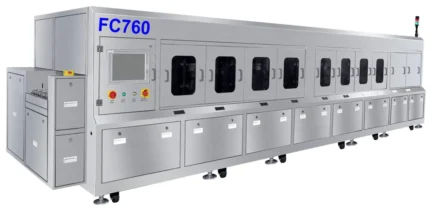
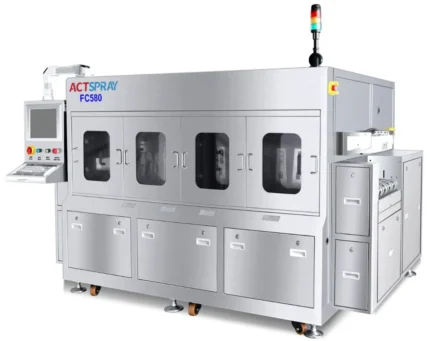
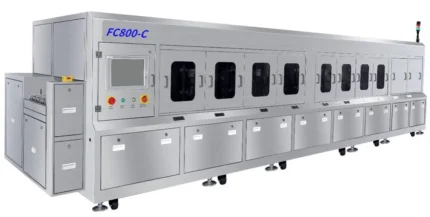
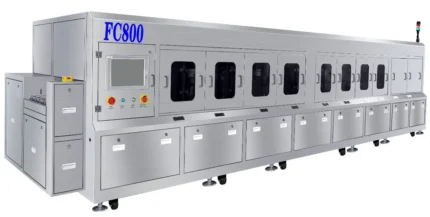
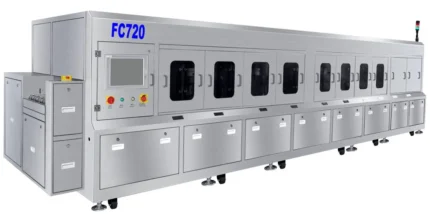
The ACTSPRAY GC860 SIP Inline Zero Wastewater Cleaning Machine is an automated inline cleaning system specially designed for removing soldering flux residues from SIP (System-in-Package) modules after assembly and soldering.
Unlike conventional aqueous cleaning systems that require large quantities of DI water for final rinsing and generate rinse wastewater, GC860 uses a closed-loop water-based cleaning and rinsing process with evaporation and condensation recovery technology. The cleaning and rinsing liquids are continuously recovered and reused, significantly reducing liquid consumption and eliminating conventional rinse wastewater discharge.
The system integrates pre-cleaning, multi-stage chemical cleaning, chemical isolation, multi-stage rinsing, air cutting and hot air drying into one continuous automated process.
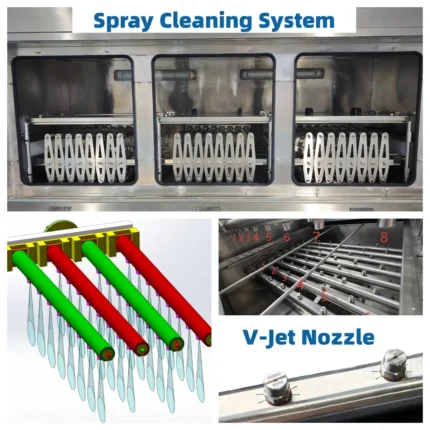
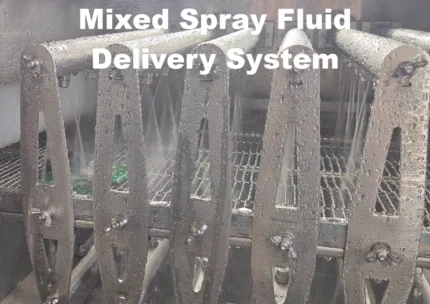
During cleaning, heated water-based cleaning chemistry softens and chemically breaks down flux residues, while high-pressure spray action physically removes the contaminants from component surfaces, solder pads and PCB areas. Multiple rinsing stages then remove remaining residues before air cutting and hot air drying complete the process.
A dedicated U-shaped condensation recovery system is installed above the cleaning and rinsing sections. Vapors generated during operation are condensed and recovered, allowing a large portion of the cleaning and rinsing liquid to be returned to the process.
This design can reduce liquid consumption by approximately 50% compared with conventional condensation methods, depending on operating conditions, while supporting a zero-rinse-wastewater cleaning process.
Key Applications
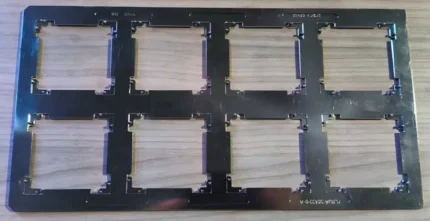
GC860 is primarily designed for automated cleaning of SIP modules after soldering and assembly.
Typical applications include:
- SIP Module Cleaning
- SIP Flux Cleaning
- SIP Assembly Cleaning
- System-in-Package Cleaning
- Semiconductor Packaging Cleaning
- Advanced Packaging Cleaning
- Post-Soldering Flux Removal
- Low-Standoff Package Cleaning
- Electronic Module Cleaning
- High-Reliability Electronics Cleaning
Typical Contaminants
GC860 is designed to remove soldering-related residues such as:
- Solder flux
- Flux residues
- Organic process residues
- Water-soluble process contaminants
- Residues around soldered components and pads
The cleaning chemistry should be selected according to the customer’s flux type, component materials and required cleanliness level.
Zero-Wastewater Cleaning Technology
Closed-Loop Cleaning and Rinsing
One of the key advantages of GC860 is its closed-loop cleaning and rinsing process.
Both the cleaning liquid and rinsing liquid use the same type of environmentally friendly water-based chemistry.
Instead of continuously consuming fresh DI water and discharging contaminated rinse water, the system uses internal circulation, overflow, evaporation and condensation recovery to reduce liquid consumption.
Process Principle
Cleaning Liquid → Rinse Process → Contaminated Liquid Recovery → Evaporation → Condensation → Liquid Recovery → Reuse
The rinsing liquid flows from the rear section toward the front section through controlled overflow.
Contaminated liquid discharged from the rinsing process is internally evaporated and condensed. The recovered liquid is then returned to the rinsing process.
When the cleaning liquid level is insufficient, cleaning solution can be replenished from the overflow area between the cleaning and rinsing sections.
This closed-loop architecture eliminates the need for conventional DI water rinsing and helps achieve a zero-rinse-wastewater cleaning process.
Cleaning Process
The complete GC860 process is:
Loading → Pre-Cleaning → Cleaning 1 → Cleaning 2 → Chemical Isolation → Pre-Rinse → Rinse 1 → Rinse 2 → Rinse 3 → Air Cutting & Drying → Hot Air Drying → Unloading
1. Pre-Cleaning
The pre-cleaning section provides initial removal of flux residues and surface contaminants.
Heated cleaning liquid and spray pressure work together to soften and loosen flux residues before the main cleaning stages.
2. Cleaning 1 & Cleaning 2
Two dedicated cleaning stages provide intensive flux removal.
The combination of:
- Heated water-based cleaning chemistry
- Chemical decomposition
- High-pressure spray impact
- Upper and lower spray coverage
helps remove flux residues from solder pads, component surfaces and difficult-to-access areas.
Cleaning temperature, spray pressure and spray angle can be adjusted according to the product and cleaning chemistry.
3. Chemical Isolation
The chemical isolation section uses adjustable air knives to minimize cleaning liquid carryover into the subsequent rinse stages.
Both air pressure and air knife angle can be adjusted.
4. Pre-Rinse
The pre-rinse stage removes residual cleaning chemistry before the main rinse stages.
5. Rinse 1, Rinse 2 & Rinse 3
Three-stage rinsing provides progressive removal of remaining flux and cleaning residues.
The rinse liquid is continuously refreshed through rear-to-front overflow.
Unlike conventional DI water rinse systems, GC860 recovers the contaminated liquid through its internal evaporation and condensation system, significantly reducing liquid consumption.
6. Air Cutting & Drying
Air cutting removes residual rinse liquid from the SIP module surface before the final thermal drying stage.
7. Hot Air Drying
The final hot air drying section removes remaining moisture and delivers a dry SIP module to the downstream production process.
The hot air temperature is adjustable up to 100°C.
Key Features
1. Zero-Rinse-Wastewater Process
GC860 is designed around a closed-loop cleaning and rinsing system that does not require conventional DI water rinsing.
The system recovers contaminated rinse liquid through evaporation and condensation, allowing the recovered liquid to be reused.
This greatly reduces liquid consumption and eliminates conventional rinse wastewater discharge.
2. U-Shaped Condensation Recovery System
Specially designed U-shaped condensers are installed above both the cleaning and rinsing sections.
Process vapors pass through the condensers, where a large portion of the vapor is condensed and recovered.
The special condensation recovery system can reduce cleaning liquid consumption by approximately 50% compared with conventional condensation methods, depending on actual process conditions.
3. Water-Based Environmentally Friendly Chemistry
GC860 uses water-based environmentally friendly cleaning and rinsing chemistry.
The same type of water-based liquid can be used in both the cleaning and rinsing process, simplifying liquid management and supporting the closed-loop cleaning concept.
4. Multi-Stage Spray Cleaning
The cleaning and rinsing sections use upper and lower spray manifolds.
Spray pressure and spray manifold angles can be adjusted according to the SIP module design and contamination requirements.
5. Variable-Frequency Spray Pressure Control
Cleaning and rinsing spray pressure can be adjusted through variable-frequency control.
Electronic pressure monitoring provides real-time process monitoring and alarm functions.
6. Adjustable Chemical Isolation Air Knives
The chemical isolation section provides adjustable:
- Air pressure
- Air knife angle
This helps reduce cleaning liquid carryover and improves separation between cleaning and rinsing stages.
7. Full SUS304 Stainless Steel Construction
The machine is constructed using 100% SUS304 stainless steel.
The material provides:
- Corrosion resistance
- High-temperature resistance
- High-pressure liquid resistance
- Mechanical durability
- Long service life
8. PC + PLC Control
The GC860 uses PC + PLC control with a Windows 10-based bilingual interface.
Operators can monitor and adjust major process parameters through the control system.
9. Real-Time Pressure Monitoring
Electronic pressure monitoring continuously monitors the pressure of the cleaning, rinsing and air systems.
Abnormal pressure conditions can trigger alarms for process protection.
10. Leakage Detection
Automatic leakage detection is provided for both the cleaning and rinsing sections.
The system can detect abnormal liquid leakage and generate an alarm.
11. Multi-Level Safety Protection
The GC860 includes:
- High and low liquid level protection
- Over-temperature protection
- Electrical over-current protection
- Electrical overload protection
- Phase-loss protection
- Phase-sequence protection
- Emergency stop protection
- Leakage detection
Emergency stop buttons are installed at the machine inlet, outlet and operator control panel.
12. Three-Layer Leak Protection
The cleaning and rinsing sections use a three-layer protection structure to reduce the risk of liquid leakage and help reduce operating noise.
13. Insulated Heating Sections
The heating sections use double-layer protection with built-in thermal insulation material.
This improves thermal insulation and helps reduce external surface temperature and operating noise.
14. SMEMA Connectivity
Standard SMEMA signal lines allow GC860 to connect with upstream and downstream equipment.
The system can be integrated with:
- PCB/SIP loading equipment
- PCB/SIP unloading equipment
- Transfer conveyors
- Automated production lines
15. MES Connectivity
Optional MES software allows the machine to communicate with the customer’s manufacturing execution system.
MES integration can support:
- Machine status monitoring
- Production management
- Process traceability
- Equipment data collection
16. Automatic Product Detection
Sensors at the machine inlet and outlet provide:
- Product detection
- Product counting
- Input/output tracking
- Timeout detection
- Blockage alarm
- Energy-saving standby
17. Energy-Saving Mode
The machine provides an energy-saving mode to reduce power and utility consumption during standby or low-production conditions.
Basic Technical Specifications
| Item | Specification |
|---|---|
| Model | GC860 |
| Brand | ACTSPRAY |
| Maximum Product Size | L400 × W600 × H100 mm |
| Conveyor Mesh Width | 600 mm |
| Conveyor Speed | 0.1–1.5 m/min |
| Transfer Direction | Left to Right |
| Conveyor Height | 920 ± 25 mm |
| Cleaning Liquid Temperature | RT–80°C |
| Pre-Rinse Liquid Temperature | RT–60°C |
| Rinse Liquid Temperature | RT–60°C |
| Hot Air Drying Temperature | RT–100°C |
| PCW Supply | <15°C |
| PCW Flow Rate | 100–120 L/min |
| PCW Pressure | >0.3 MPa |
| Exhaust Air Volume | 60 m³/min |
| Total Power | 202 kW |
| Power Supply | AC 380 V, 3 Phase, 50 Hz |
| Rated Current | 350 A |
| Compressed Air Supply | 0.5–0.7 MPa |
| Compressed Air Consumption | 200 L/min |
| Machine Dimensions | Approx. L8600 × W1850 × H1920 mm |
| Machine Weight | Approx. 5200 kg |
| Control System | PC + PLC |
| Operation Interface | Windows 10, Chinese / English |
| SMEMA Interface | Standard |
| MES Connection | Optional |
RT = Room Temperature. Final machine dimensions are subject to the approved equipment layout. Actual process parameters may be optimized according to SIP design, flux type, cleaning chemistry and required cleanliness level.
Why Choose the GC860?
The GC860 SIP Inline Zero Wastewater Cleaning Machine is designed for manufacturers looking to reduce water consumption and wastewater treatment requirements while maintaining reliable flux removal performance.
Its combination of heated chemical spray cleaning, multi-stage rinsing, closed-loop liquid recovery, condensation technology and hot air drying provides a complete automated SIP cleaning process.
The integrated condensation recovery system recovers cleaning and rinsing liquid from process vapors, while the closed-loop rinse process significantly reduces liquid consumption and eliminates conventional rinse wastewater discharge.
With inline conveyor transport, SMEMA connectivity and optional MES integration, GC860 can be incorporated directly into automated SIP module production lines.
Key Benefits
Zero Rinse Wastewater
Closed-loop rinsing and evaporation-condensation recovery eliminate conventional DI water rinse wastewater.
Reduced Liquid Consumption
The dedicated U-shaped condensation recovery system can reduce cleaning liquid consumption by approximately 50% compared with conventional condensation methods, depending on operating conditions.
High Cleaning Performance
Heated chemistry combined with multi-stage high-pressure spray cleaning provides effective flux removal after SIP soldering.
Automated Inline Operation
Continuous mesh conveyor transport allows the machine to operate as part of an automated SIP production line.
Process Control
Cleaning temperature, rinse temperature, spray pressure, air knife pressure and drying temperature can be monitored and adjusted.
Factory Automation
SMEMA connectivity and optional MES integration support automated production and process monitoring.