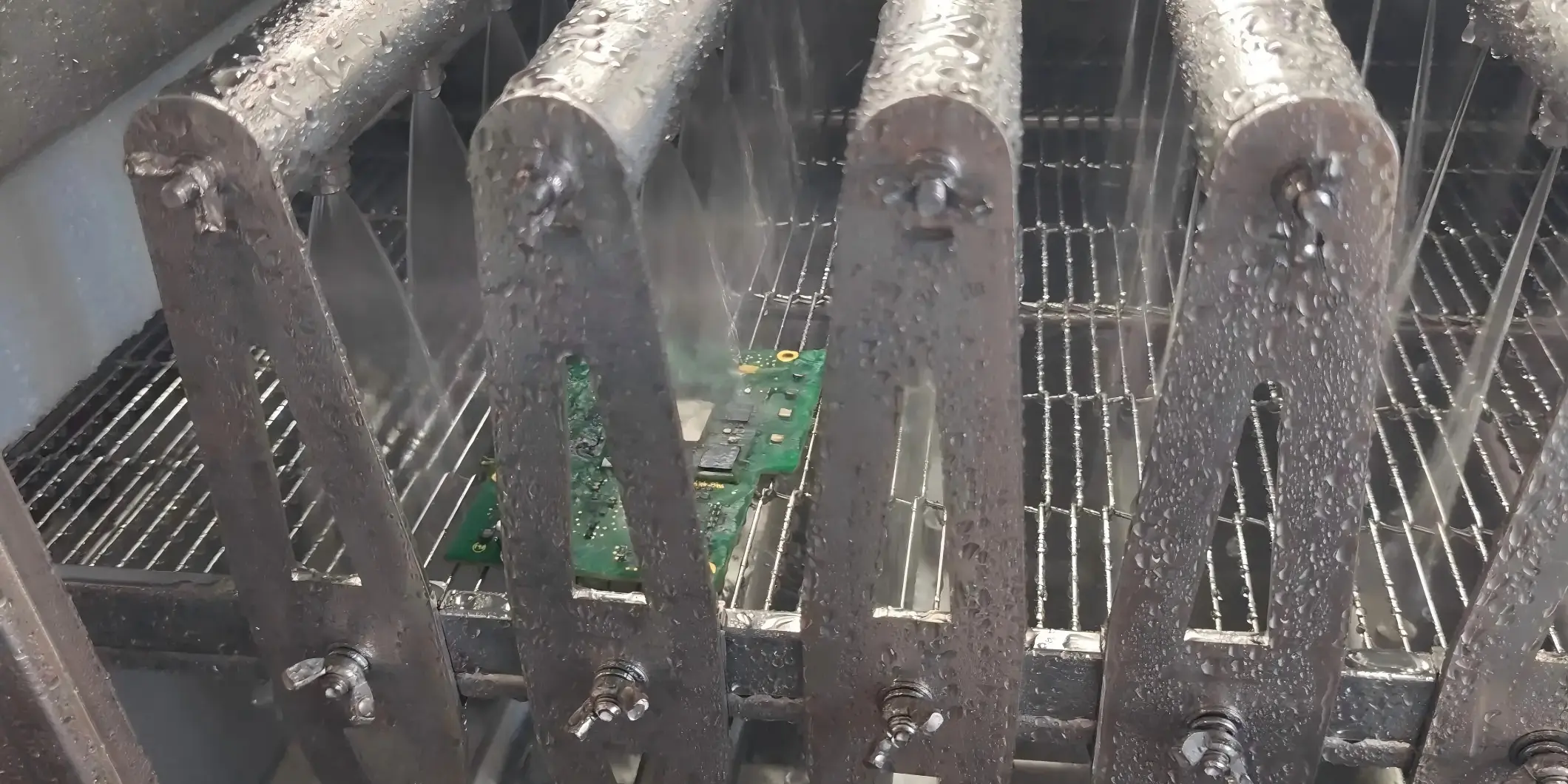
What Does Zero-Wastewater Rinsing Mean?
In semiconductor and electronic package cleaning, the term zero-wastewater cleaning can be misleading if the washing and rinsing processes are not clearly distinguished.
The washing process and the rinsing process have different liquid-management methods.
The washing liquid is normally circulated and reused during production, with the solution replaced periodically according to process requirements.
The bigger wastewater issue often comes from the rinsing process, where conventional systems continuously use DI water to remove residual cleaning chemistry from the product surface.
This is where zero-wastewater rinsing becomes relevant.
Why Does the Rinsing Process Generate Wastewater?
A conventional aqueous cleaning process may use a sequence such as:
Chemical Washing → DI Water Rinsing → Drying
During rinsing, fresh DI water is continuously supplied to remove residual cleaning solution.
The used DI water then leaves the machine as rinse wastewater.
For high-volume semiconductor cleaning, continuous DI water consumption can result in a substantial amount of wastewater.
For example, depending on operating conditions, a conventional inline cleaning process may generate approximately 500–800 L/h of rinse wastewater.
This wastewater then needs to be collected and treated.
How Is Zero-Wastewater Rinsing Different?
Instead of continuously using fresh DI water and discharging the used rinse water, GC860 uses chemical cleaning liquid for the rinsing process.
The rinse liquid is then:
Rinsing → Recovery → Distillation → Reuse
The recovered liquid is processed through a distillation system to remove contaminants before being returned to the process.
This means the rinse liquid does not have to be continuously discharged as conventional rinse wastewater.
Washing and Rinsing Have Different Liquid Cycles
This distinction is important when evaluating a semiconductor cleaning system.
Washing Process
Chemical Cleaning Liquid → Circulation → Reuse → Periodic Replacement
The washing solution is already designed as a circulating process.
GC860 Rinsing Process
Chemical Liquid Rinsing → Recovery → Distillation → Reuse
The zero-wastewater concept is specifically focused on this rinse-liquid cycle.
Why Is This Important for Semiconductor Packaging?
Advanced semiconductor packages such as SiP can contain complex structures, solder joints and narrow gaps where flux residues need to be removed.
The cleaning process therefore needs to provide effective chemical washing and rinsing while maintaining stable production conditions.
At the same time, semiconductor factories may need to manage:
- DI water consumption
- Rinse wastewater
- Wastewater treatment capacity
- Factory utilities
- Environmental requirements
- Operating costs
A zero-wastewater rinsing approach addresses the wastewater generated by the conventional DI-water rinsing stage.
How Does GC860 Achieve Zero-Wastewater Rinsing?
The GC860 integrates:
- Chemical washing
- Chemical liquid rinsing
- Rinse-liquid recovery
- Distillation
- Liquid reuse
- Air knives drying
- Hot-air drying
The recovered rinse liquid is processed through distillation and returned to the cleaning process.
The objective is to avoid the continuous discharge of conventional rinse wastewater.
Zero-Wastewater Does Not Mean “No Liquid”
Zero-wastewater rinsing does not mean that the cleaning process operates without liquid.
It means that the rinse liquid is recovered and reused instead of continuously discharged.
Fresh liquid may still be required for replenishment, depending on contamination loading and operating conditions.
Therefore, actual liquid consumption should always be evaluated according to:
- Product type
- Flux contamination
- Production volume
- Cleaning chemistry
- Operating parameters
Conclusion
The key to zero-wastewater semiconductor cleaning is not necessarily eliminating the rinsing process.
It is changing how the rinse liquid is supplied, recovered, purified and reused.
GC860 applies this concept specifically to the rinsing process, replacing conventional continuous DI-water rinsing with a chemical liquid rinsing and recovery-distillation-reuse process.