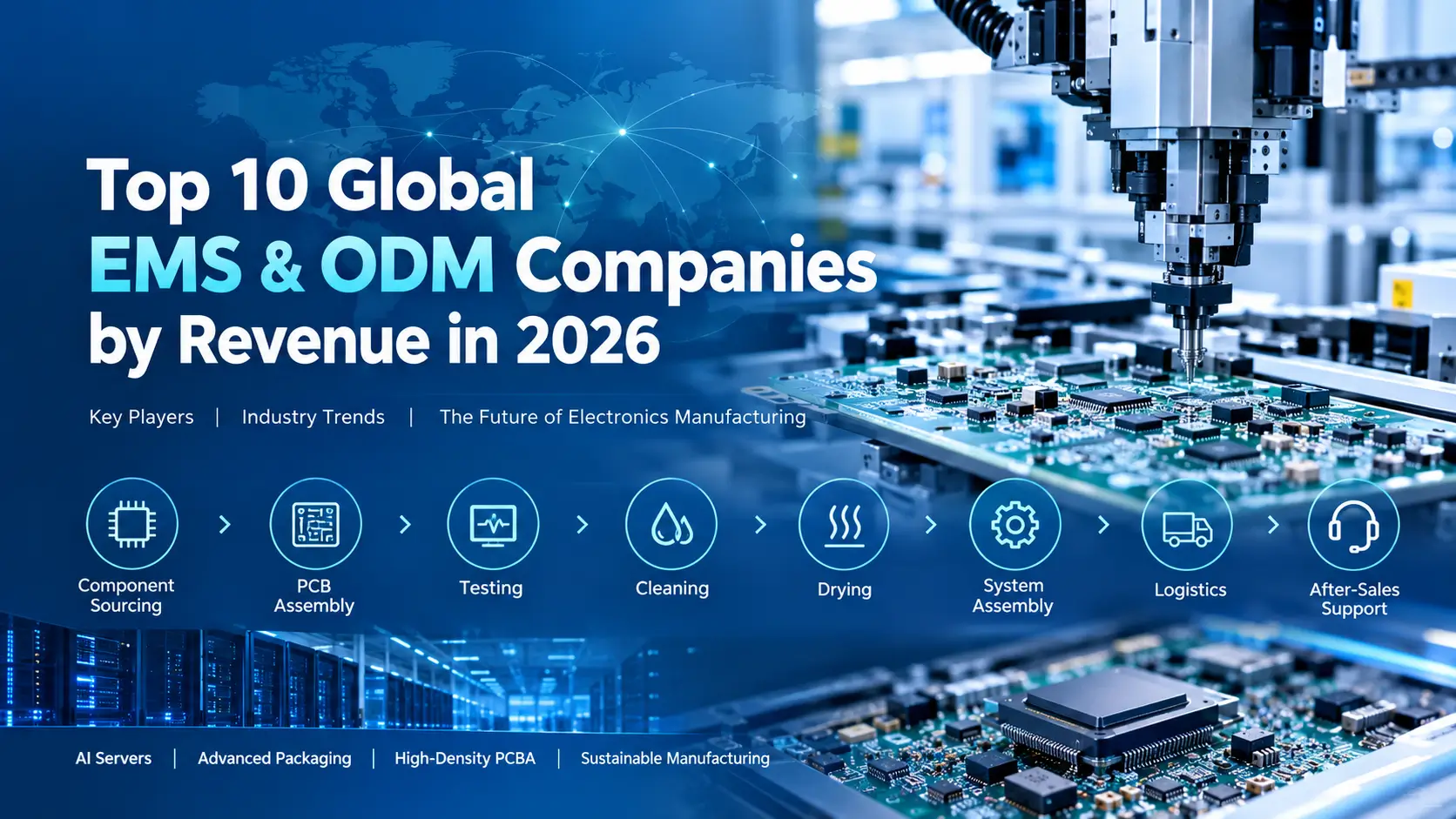
Electronics Manufacturing Services (EMS) is the backbone of the global hardware supply chain. EMS providers handle PCB assembly, full-unit manufacturing, testing, supply chain management, and end-of-life services for brand owners. Driven by soaring demand for AI servers, automotive electronics, industrial controls, and medical devices, the revenue of leading EMS firms continues to expand. Based on the latest financial reports and industry data from EMSNOW and in4ma, this article ranks the Top 10 global EMS companies by revenue in 2026 and highlights each player’s business focus and market strategy.
Global Top 10 EMS Companies by Revenue
| Rank | Company | Headquarters | 2025 Revenue |
|---|---|---|---|
| 1 | Hon Hai Technology Group (Foxconn) | Taiwan | US$259.99 billion |
| 2 | Wistron | Taiwan | US$70.16 billion |
| 3 | Quanta Computer | Taiwan | US$68.14 billion |
| 4 | Luxshare Precision | China | US$46.62 billion |
| 5 | Pegatron | Taiwan | US$35.84 billion |
| 6 | Jabil | United States | US$31.11 billion |
| 7 | Flex | United States | US$27.91 billion |
| 8 | BYD Electronics | China | US$25.18 billion |
| 9 | Compal Electronics | Taiwan | US$24.30 billion |
| 10 | Huaqin Technology | China | US$24.05 billion |
*Source: EMSNow / in4ma, EMS & ODM Global 100, 2025 revenue ranking. Revenue figures are presented in the ranking’s reported U.S. dollar values. *
1. Foxconn
Hon Hai Technology Group (Foxconn) is the world’s largest company in the latest EMS/ODM revenue ranking.
According to EMSNow’s 2025 ranking, Foxconn generated approximately US$260 billion in revenue, far exceeding the other companies on the list.
Foxconn operates a global manufacturing network serving major customers across consumer electronics, cloud and networking products, computing, automotive electronics and other industries.
Its manufacturing capabilities extend far beyond final assembly. They include component integration, precision manufacturing, PCBA, system assembly, testing and supply-chain management.
Foxconn’s 2025 financial results also showed the increasing importance of AI-related manufacturing. The company reported full-year 2025 revenue of approximately NT$8.1 trillion, up 18% year over year, while cloud and networking products became its largest product category in the fourth quarter. Foxconn also highlighted AI as a major driver of its future growth strategy.
Key manufacturing areas:
- Consumer electronics
- Computing and networking
- AI servers
- Cloud infrastructure
- Automotive electronics
- Precision components
- PCBA and system assembly
2. Wistron
Wistron Corporation is a major Taiwan-based electronics manufacturer with extensive capabilities in computing, cloud infrastructure and smart devices.
The company ranked second in the 2025 EMS/ODM revenue ranking, with approximately US$70.16 billion in reported revenue.
Wistron’s own 2025 financial announcement reported consolidated revenue of NT$2.187 trillion. The company also announced additional investments in manufacturing facilities and equipment to support its AI-related business, including expansion of AI server manufacturing capacity in Mexico.
The growth of AI servers is changing the manufacturing requirements for large electronics manufacturers. Higher power density, complex PCB assemblies, advanced thermal management and increasingly sophisticated testing all place greater demands on manufacturing processes.
3. Quanta Computer
Quanta Computer is another major Taiwan-based electronics manufacturer and one of the world’s largest notebook and computing hardware manufacturers.
It ranked third in the latest global EMS/ODM ranking, with approximately US$68.14 billion in 2025 revenue.
Quanta has expanded its manufacturing capabilities beyond traditional notebook computers into:
- Cloud computing
- Data centers
- Servers
- AI computing
- Automotive electronics
- Smart healthcare
- Networking equipment
The rapid expansion of AI computing has increased demand for high-performance servers and complex electronic assemblies, creating new opportunities and manufacturing challenges for large EMS/ODM companies.
4. Luxshare Precision
Luxshare Precision Industry is one of the fastest-growing major electronics manufacturers in China.
The company ranked fourth, with approximately US$46.62 billion in 2025 revenue according to the EMSNow/in4ma ranking.
Luxshare has developed manufacturing capabilities across multiple electronics segments, including:
- Consumer electronics
- Communication products
- Connectors
- Precision components
- Automotive electronics
- Acoustic products
- Smart devices
Its growth illustrates the increasing role of Chinese manufacturers in the global electronics manufacturing supply chain.
As products become smaller and more integrated, manufacturers increasingly need to control not only assembly but also precision components, interconnects and manufacturing processes.
5. Pegatron
Pegatron Corporation is a Taiwan-based electronics manufacturing company providing manufacturing and development services to global customers.
It ranked fifth in the 2025 global EMS/ODM ranking, with approximately US$35.84 billion in revenue.
Pegatron’s manufacturing portfolio includes consumer electronics, computing products, communications equipment, automotive electronics and other electronic systems.
For large-volume electronics production, manufacturing efficiency, process consistency, automated inspection and production-line integration are essential to maintaining quality and controlling costs.
6. Jabil
Jabil Inc. is one of the largest U.S.-based electronics manufacturing services companies.
Jabil ranked sixth in the latest global EMS/ODM ranking, with approximately US$31.11 billion in 2025 revenue.
Jabil operates manufacturing facilities across multiple regions and serves industries including:
- Automotive
- Healthcare
- Cloud and data centers
- Networking
- Consumer electronics
- Industrial equipment
- Energy
Unlike manufacturers focused primarily on consumer electronics, Jabil has a broad industrial and technology manufacturing portfolio.
Its manufacturing services can cover design support, supply-chain management, PCB assembly, system integration, testing and logistics.
7. Flex
Flex Ltd. is another major global EMS provider headquartered in the United States.
With approximately US$27.91 billion in 2025 revenue, Flex ranked seventh in the latest EMS/ODM Global 100 ranking.
Flex provides manufacturing services across a wide range of markets, including:
- Automotive
- Healthcare
- Industrial
- Communications
- Cloud infrastructure
- Consumer products
Its global manufacturing footprint allows customers to distribute production across different regions while maintaining standardized manufacturing processes and supply-chain management.
8. BYD Electronics
BYD Electronics is part of the broader BYD Group and has become a major player in global electronics manufacturing.
It ranked eighth in the 2025 EMS/ODM revenue ranking, with approximately US$25.18 billion in reported revenue.
The company’s capabilities extend across:
- Smartphones and consumer electronics
- Automotive electronics
- Components
- Smart products
- New energy-related electronics
- Precision manufacturing
BYD Electronics demonstrates how the boundaries between electronics manufacturing, component manufacturing and automotive electronics are becoming increasingly interconnected.
9. Compal Electronics
Compal Electronics is a Taiwan-based electronics manufacturer with a long history in computing and electronics manufacturing.
It ranked ninth in the latest global EMS/ODM ranking, with approximately US$24.30 billion in 2025 revenue.
Compal’s manufacturing and development capabilities cover areas such as:
- Notebook computers
- Servers
- Smart devices
- Automotive electronics
- IoT products
- Displays and related systems
As the electronics industry shifts toward connected devices and intelligent systems, EMS companies increasingly need capabilities that extend beyond traditional PC assembly.
10. Huaqin Technology
Huaqin Technology is a China-based electronics design and manufacturing company specializing in smart devices and related electronics.
It ranked tenth in the 2025 global EMS/ODM ranking, with approximately US$24.05 billion in revenue.
Huaqin’s business includes product development, design, manufacturing and supply-chain services for products such as smartphones, tablets, laptops, smart hardware and other intelligent electronic devices.
Its position in the global ranking reflects the continued importance of integrated design and manufacturing capabilities in the consumer electronics sector.
What Is Driving the Growth of Global EMS Companies?
The world’s largest EMS and ODM companies are no longer simply contract assembly factories.
Several major trends are reshaping the industry.
1. AI Servers and Data Centers
AI computing has become one of the most important growth areas for electronics manufacturing.
AI servers require high-performance processors, high-density PCB assemblies, advanced power systems, high-speed interconnects and sophisticated thermal management.
This has increased the manufacturing complexity of server and data-center products.
Foxconn, Wistron and Quanta have all highlighted AI and cloud infrastructure as important areas of their current manufacturing strategies.
2. Higher-Density Electronic Assemblies
Electronic products are becoming smaller while their computing and communication capabilities continue to increase.
This means manufacturers are dealing with:
- Smaller components
- Finer-pitch packages
- Higher component density
- Lower package standoff heights
- More complex PCB layouts
- More demanding reliability requirements
Advanced packages such as BGA, LGA, FCBGA, FCCSP, SiP and other high-density packages require tighter control throughout the manufacturing process.
3. Advanced PCBA Manufacturing
PCBA remains one of the fundamental building blocks of modern electronic products.
A typical high-volume PCBA manufacturing process can include:
Solder Paste Printing → SPI → SMT Placement → Reflow → AOI → Testing → Cleaning → Drying → Final Assembly
As component density increases, manufacturing processes become increasingly sensitive to soldering residues, particles and other contaminants.
For applications with strict reliability requirements, PCBA cleaning can therefore become an important part of the overall manufacturing process.
4. Automotive and Industrial Electronics
EMS companies are also expanding their presence in automotive electronics, industrial controls, communication systems and medical devices.
These applications often require longer product lifecycles and higher reliability than conventional consumer electronics.
As a result, manufacturers may need more rigorous process control, traceability, testing and cleanliness management.
PCBA Cleaning in Modern EMS Manufacturing
For high-volume EMS production, cleaning is not simply a post-processing step.
The appropriate cleaning process needs to be considered together with:
- Flux chemistry
- PCB design
- Component density
- Package type
- Component standoff
- Production throughput
- Cleanliness requirements
- Rinsing quality
- Drying performance
- Water consumption
- Wastewater management
For example, BGA, LGA, QFN and advanced semiconductor packages can present different cleaning challenges because of their relatively small gaps and complex geometries.
For high-volume production, automated inline PCBA cleaning systems can provide controlled washing, rinsing and drying while maintaining consistent process parameters.
In addition, modern electronics manufacturers are paying increasing attention to water consumption and wastewater management.
This has encouraged the development of more efficient approaches to:
- DI-water management
- Rinse-water recycling
- Chemical management
- Wastewater treatment
- Zero-wastewater rinsing processes
These considerations are becoming increasingly relevant as EMS companies expand production while also improving manufacturing efficiency and environmental performance.
The EMS Industry Is Moving Toward More Integrated Manufacturing
The latest global EMS/ODM ranking shows a highly concentrated industry, with major manufacturers from Taiwan, China and the United States occupying most of the top positions.
However, revenue scale is only one indicator of manufacturing capability.
The competitive landscape is increasingly shaped by a combination of:
Design + Supply Chain + PCBA + Advanced Packaging + Testing + System Assembly + Automation + Process Control
At the same time, the rise of AI servers, automotive electronics, advanced semiconductor packaging and high-density electronic modules is creating new requirements throughout the manufacturing process.
For EMS and OEM/ODM manufacturers, maintaining stable and repeatable production quality requires attention to every stage—from component sourcing and SMT assembly to inspection, cleaning, drying and final testing.
As electronics continue to become more compact, powerful and complex, manufacturing technology will remain a critical part of the global electronics industry.
The future of EMS is therefore not simply about producing more units. It is about building more integrated, automated, traceable and reliable manufacturing systems capable of supporting increasingly complex electronic products.