As electronic assemblies become smaller and more complex, cleaning after soldering becomes increasingly challenging.
FCBGA, QFN, SiP and fine-pitch components often have limited clearance between the component body and PCB surface. Flux residues trapped in these areas can be difficult to remove.
Vertical spray cleaning is one of the methods used to address these challenges in batch PCBA manufacturing.
1. What Is Vertical Spray Cleaning?
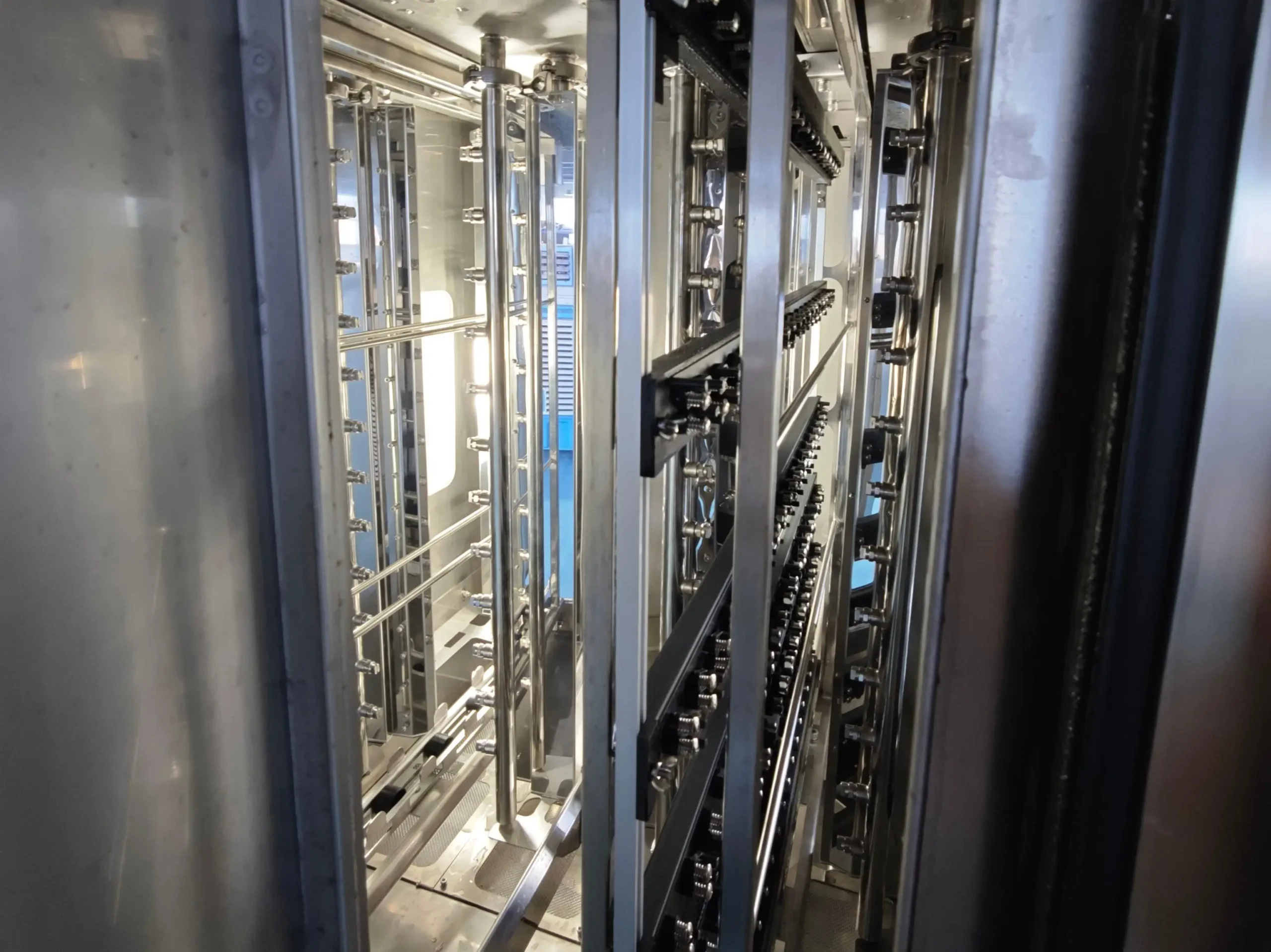
Vertical spray cleaning is a process in which PCBA assemblies are positioned vertically inside a cleaning chamber.
Cleaning liquid is delivered through spray manifolds toward the assemblies.
Depending on equipment design, the spray manifolds, fixtures or both may move during the cleaning cycle.
The purpose is to provide controlled spray exposure across the PCB surface and around mounted components.
2. Why Is Spray Coverage Important?
Cleaning performance depends on several factors working together:
- Cleaning chemistry
- Spray pressure
- Spray nozzle configuration
- Distance between nozzles and PCB
- Component geometry
- Cleaning time
- Liquid exchange around difficult-to-reach areas
High spray pressure alone does not guarantee better cleaning.
Excessive mechanical force may also affect sensitive components or assemblies.
The process must be optimized for each PCB design.
3. Fixed Spray Manifolds and Moving Fixtures


One equipment configuration uses fixed spray manifolds and moving PCB fixtures.
In this arrangement, the spray system remains in position while the fixture carrying the PCB moves back and forth.
This design provides repeated spray exposure without requiring the spray manifolds themselves to move.
The ACTSPRAY AC620 adopts this structure with vertical loading and two independent cleaning chambers.
Each chamber is equipped with four spray manifolds and four drying air knives on each side.
4. Typical Applications
Vertical spray cleaning can be evaluated for:
FCBGA Assemblies
For removing flux residues around solder balls and beneath FCBGA packages.
QFN Components
For cleaning residues around bottom-terminated components with limited access.
SiP Modules
For assemblies with compact package structures and high component density.
Fine-Pitch PCB Assemblies
For electronic products where small spacing and dense layouts make conventional cleaning difficult.
The suitability of the process depends on the actual package geometry and contamination profile.
5. What Parameters Should Be Controlled?
A stable cleaning process requires control of several parameters.
| Parameter | Function |
|---|---|
| Cleaning temperature | Supports cleaning chemistry |
| Spray pressure | Provides mechanical cleaning force |
| Cleaning time | Determines exposure duration |
| Rinse cycles | Removes dissolved residues and chemistry |
| DI water quality | Supports final rinsing |
| Drying temperature | Removes remaining moisture |
These parameters should be recorded and validated for repeatable production.
6. Why Choose a Dual-Lane Vertical Batch System?
For manufacturers handling multiple PCB assemblies, equipment loading capacity is an important consideration.
The AC620 has two vertical loading lanes and two independent cleaning chambers.
Each lane accommodates a fixture measuring up to 750 × 750 × 40 mm.
Two rows of PCBA can be processed simultaneously, helping improve batch handling efficiency.
Conclusion
Vertical spray cleaning provides a practical approach for batch PCBA applications involving complex component structures.
However, successful cleaning depends on the complete process rather than spray direction alone.
Before production implementation, manufacturers should evaluate actual PCB samples, cleaning chemistry, spray parameters and final cleanliness requirements.