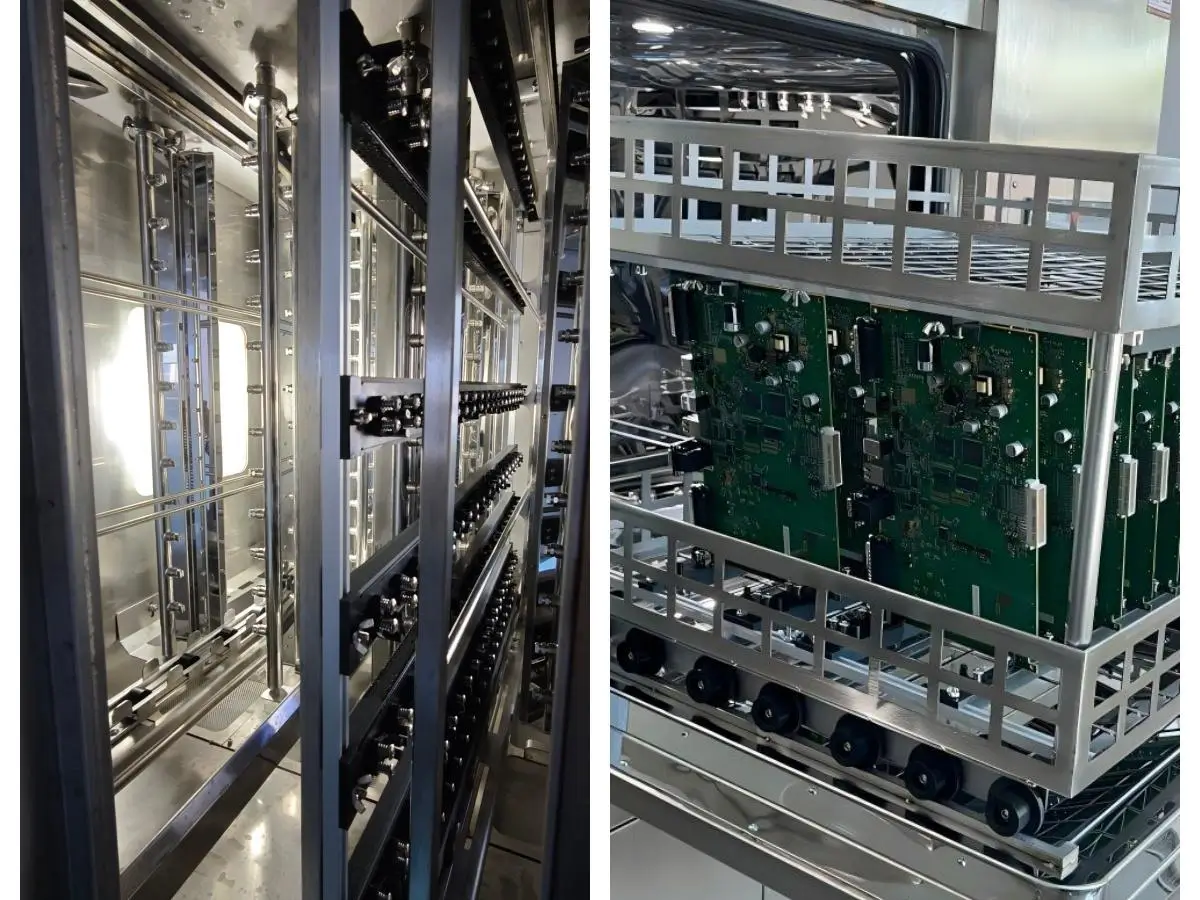
Printed Circuit Board Assembly (PCBA) cleaning is an important manufacturing process for removing flux residues and other contaminants after soldering.
A properly designed cleaning process helps manufacturers control surface contamination and meet application-specific cleanliness requirements.
For industrial electronics, automotive electronics and other high-reliability assemblies, the cleaning process should be developed according to the PCB design, flux chemistry and final product requirements.
1. Why Clean PCBA After Soldering?
Flux is used during soldering to support proper solder wetting and joint formation.
However, residual flux may remain on the assembly after reflow or wave soldering.
Depending on its chemical composition and environmental conditions, contamination may contribute to corrosion, leakage currents and electrochemical migration.
Cleaning requirements therefore depend on the type of flux, product application and reliability expectations.
2. Stage One: Chemical Washing
Chemical washing is the primary stage for removing flux residues.
A suitable cleaning agent is selected according to the flux chemistry.
During washing, the cleaning solution interacts with the contamination while spray action helps remove loosened residues from the PCB surface.
Important parameters include:
- Cleaning agent type
- Chemical concentration
- Cleaning temperature
- Spray pressure
- Cleaning duration
- Filtration condition
The cleaning solution should be compatible with the PCB, solder joints, connectors and sensitive components.
3. Stage Two: DI Water Rinsing
After chemical washing, the board needs an appropriate rinsing process.
Deionized (DI) water is commonly used to remove dissolved contaminants and remaining cleaning chemistry.
DI water quality is important because dissolved ions can remain on the PCB if rinsing is insufficient.
The required rinse cycles depend on the contamination load and cleanliness specification.
Resistivity monitoring can help operators monitor rinse-water quality.
4. Stage Three: Hot Air Drying
Following rinsing, moisture may remain around components, connectors and other PCB structures.
Hot air drying helps remove this moisture.
The drying temperature and duration should be selected according to PCB materials, component temperature limits and board geometry.
For assemblies with narrow gaps or complex structures, drying performance should be checked carefully.
5. Why Process Parameter Control Matters
A cleaning machine should provide consistent control of the main process parameters.
| Parameter | Cleaning purpose |
|---|---|
| Chemical temperature | Supports chemical action |
| Spray pressure | Provides mechanical force |
| Washing time | Controls cleaning exposure |
| Rinse cycles | Supports residue removal |
| DI water quality | Controls rinsing conditions |
| Drying temperature | Supports moisture removal |
Changing one parameter may influence the overall cleaning result.
For this reason, production parameters should be documented and validated.
6. Equipment for Batch PCBA Cleaning
For manufacturers using batch PCBA cleaning processes, selecting the right equipment depends on PCB dimensions, production volume, component structure and cleaning requirements.
ACTSPRAY offers different batch cleaning configurations, including the AC530 and AC620, to support various electronics manufacturing applications.
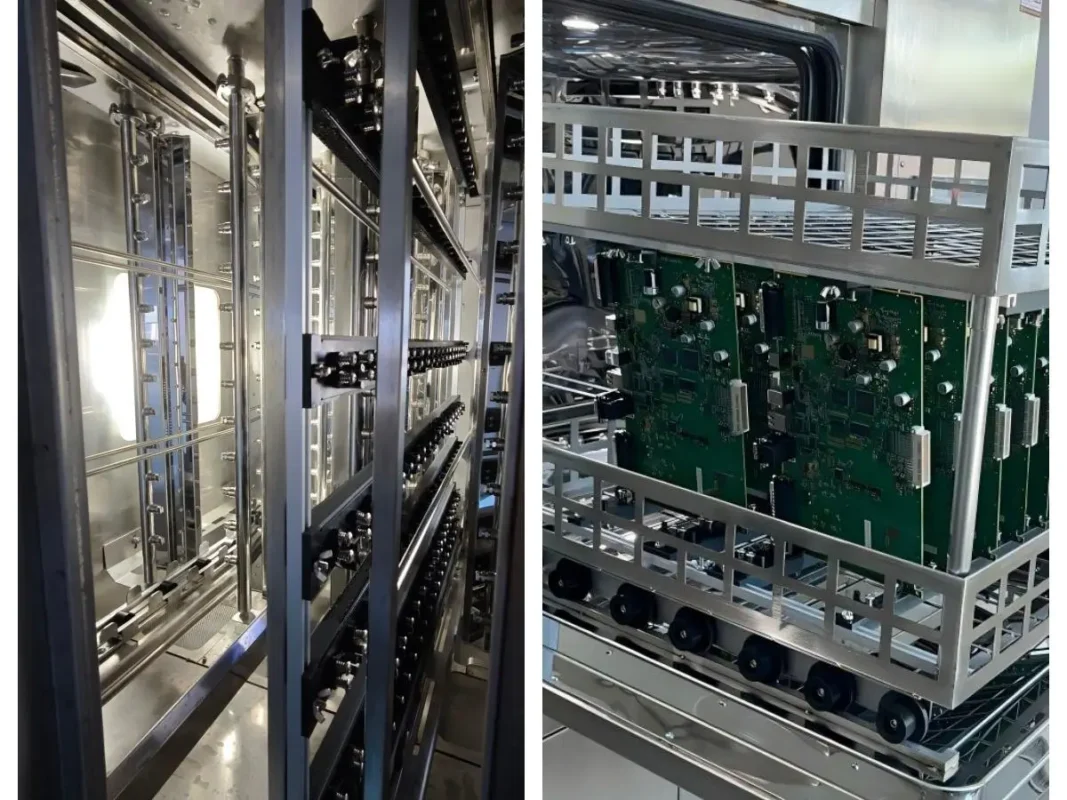
AC530: Basket Loading Batch PCBA Cleaning Machine
The ACTSPRAY AC530 is designed for batch cleaning of PCB assemblies after soldering.
It integrates chemical washing, DI water rinsing and hot air drying into one machine. The cleaning process can be adjusted according to flux type, contamination level and PCB requirements.
Key features include:
- Batch spray cleaning design
- Integrated washing, rinsing and drying processes
- Adjustable cleaning temperature and spray pressure
- Programmable cleaning and rinsing cycles
- Suitable for BGA, QFN and other PCBA assemblies
The AC530 is a practical option for manufacturers requiring a flexible batch cleaning solution.
AC620: Dual-Lane Vertical Loading Batch PCBA Cleaning Machine
For manufacturers requiring higher batch loading capacity, the ACTSPRAY AC620 provides a dual-lane configuration with two independent cleaning chambers.
Its vertical loading design allows two rows of PCBA assemblies to be processed simultaneously.
Key features include:
- Two vertical loading lanes
- Two independent cleaning chambers
- Chemical washing, DI water rinsing and hot air drying
- Adjustable cleaning, rinsing and drying parameters
- Maximum fixture size of 750 × 750 × 40 mm per lane
- Suitable for BGA, QFN, SiP, CSP and fine-pitch PCBA assemblies
The dual-lane design helps improve batch loading efficiency and supports manufacturers handling larger quantities of PCB assemblies.
AC530 vs. AC620: Which One Should You Choose?
| Comparison | AC530 | AC620 |
|---|---|---|
| Configuration | Dual layer of basket | Dual-chamber, dual-lane system |
| Loading design | Basket loading | Vertical dual-lane fixture loading |
| Application | General PCBA batch cleaning | Higher-capacity and precision PCBA cleaning |
The choice between AC530 and AC620 should be based on actual production requirements, PCB dimensions, fixture loading quantity and target cleaning cycle time.
Both machines can be evaluated using customer PCB samples to establish suitable washing, rinsing and drying parameters.
Explore ACTSPRAY Batch PCBA Cleaning Solutions: