As AI clusters, cloud computing, and high-performance data centers continue to demand higher bandwidth, optical interconnect technology is evolving rapidly. Traditional pluggable optical transceivers are gradually reaching their physical limits, leading to the emergence of Near-Packaged Optics (NPO) and Co-Packaged Optics (CPO).
Although these technologies all enable optical communication, they differ significantly in architecture, performance, manufacturing complexity, and future applications.
This article explains the key differences between Traditional Optical Modules, NPO, and CPO, and why these technologies matter to the semiconductor and precision cleaning industries.
What Are Traditional Optical Modules?
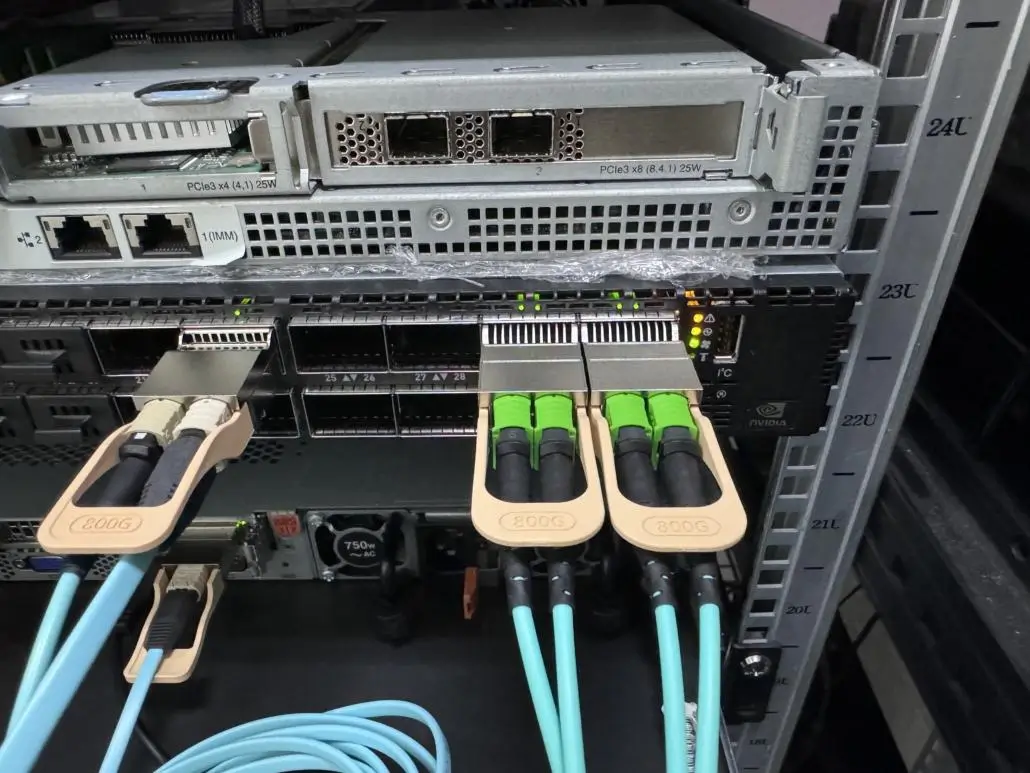
Traditional optical modules are the most widely deployed optical interconnect solution in today’s data centers.
Common form factors include:
- QSFP28
- QSFP-DD
- OSFP
- CFP
In this architecture, the switch ASIC sends high-speed electrical signals across the PCB to a pluggable optical transceiver located at the front panel of the switch. The optical module then converts the electrical signals into optical signals for transmission through fiber.
Advantages
- Mature technology
- Hot-swappable design
- Easy maintenance and replacement
- Lowest deployment cost
- Well-established supply chain
Limitations
As transmission speeds increase from 400G to 800G and eventually 1.6T, electrical signals must travel longer distances across the PCB, resulting in:
- Higher insertion loss
- Increased power consumption
- Greater signal integrity challenges
- More complex equalization and retimer requirements
These limitations are driving the industry toward new optical integration architectures.
What Is Near-Packaged Optics (NPO)?
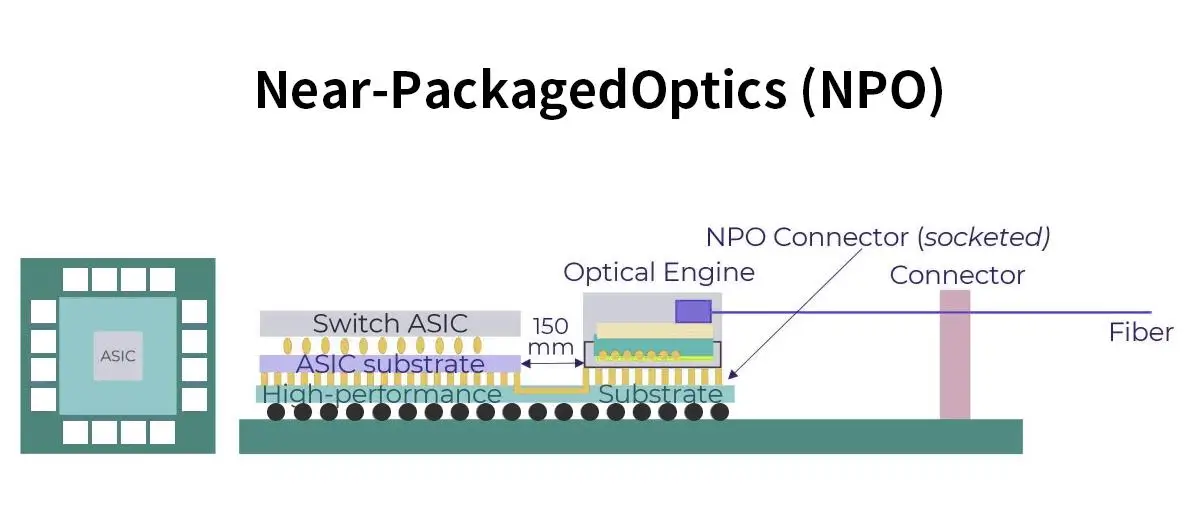
Near-Packaged Optics (NPO) moves the optical engine much closer to the switch ASIC.
Unlike traditional optical modules located at the edge of the switch, NPO places the optical engine only a few millimeters or centimeters away from the ASIC. However, they remain separate components rather than being integrated into a single package.
Benefits of NPO
- Shorter high-speed electrical paths
- Reduced PCB transmission loss
- Lower power consumption
- Improved signal integrity
- Easier manufacturing than CPO
Because the ASIC and optical engine are manufactured, tested, and assembled independently, NPO offers better production flexibility and higher manufacturing yield than fully integrated solutions.
Many industry experts view NPO as a practical transition technology between traditional pluggable optics and CPO.
What Is Co-Packaged Optics (CPO)?
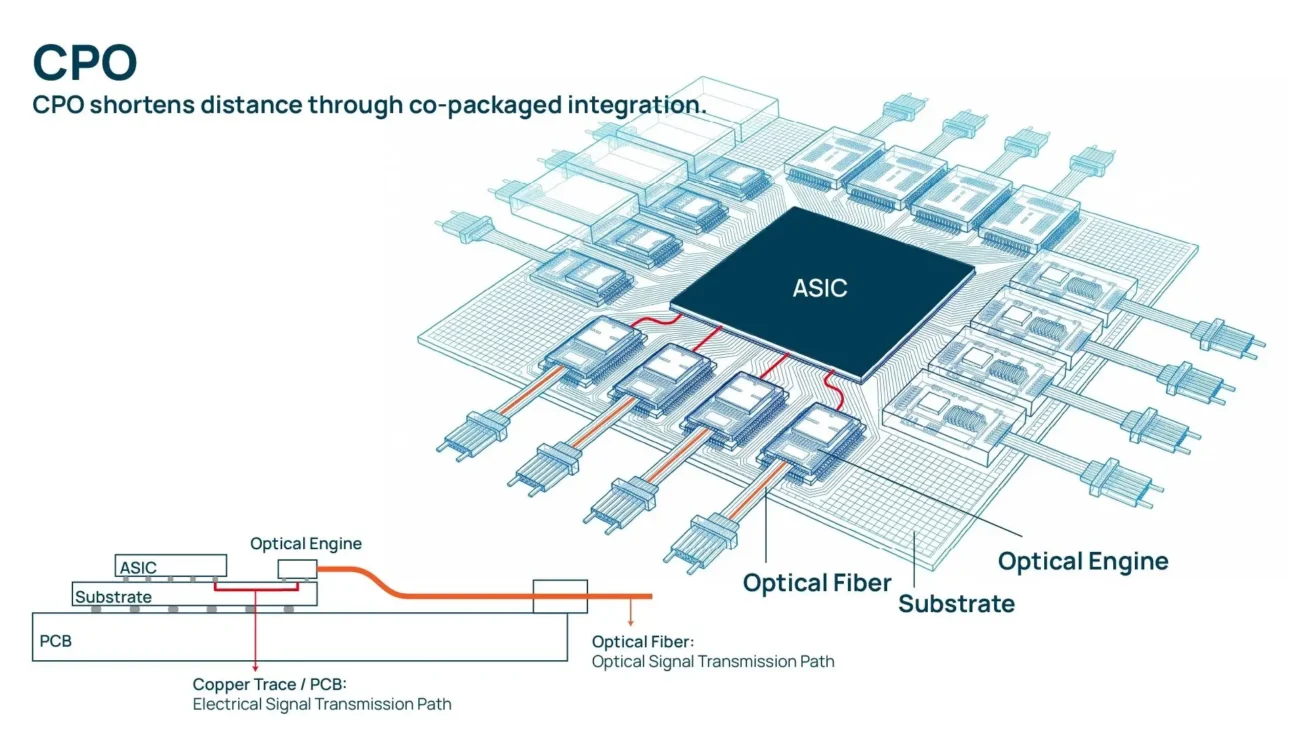
Co-Packaged Optics (CPO) represents the next generation of optical interconnect architecture.
Instead of placing optical modules on the front panel, CPO integrates multiple optical engines directly into the same package as the switch ASIC.
The electrical connection between the ASIC and optical engines becomes extremely short, dramatically reducing transmission losses while improving bandwidth and energy efficiency.
Advantages of CPO
- Minimal electrical transmission distance
- Lowest insertion loss
- Lowest power consumption
- Highest bandwidth density
- Supports future switch capacities of 51.2T, 102.4T, and beyond
- Enables scalable AI and hyperscale data center infrastructure
Challenges
Despite its advantages, CPO introduces new engineering challenges, including:
- Complex thermal management
- More difficult maintenance and repair
- Higher manufacturing cost
- Advanced packaging requirements
- More stringent reliability standards
As a result, CPO is currently being adopted primarily in next-generation AI networking and hyperscale cloud applications.
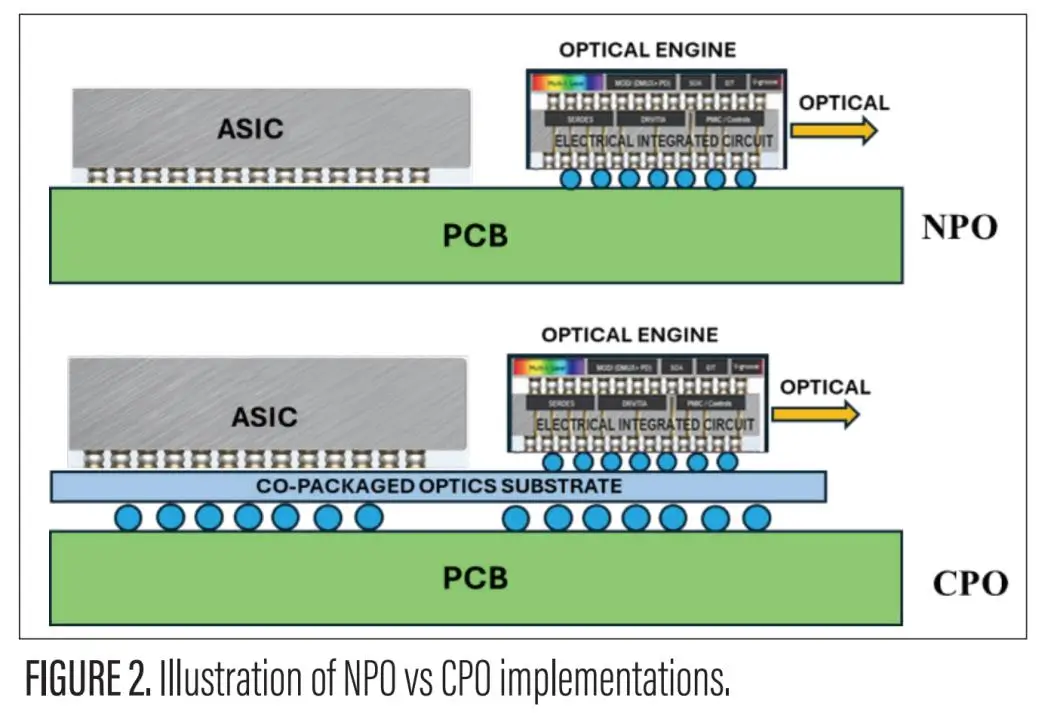
CPO vs. NPO vs. Traditional Optical Modules
| Feature | Traditional Optical | NPO | CPO |
|---|---|---|---|
| Optical Engine Location | Front-panel pluggable module | Close to ASIC | Inside ASIC package |
| Package Integration | No | No | Yes |
| Electrical Path Length | Long | Short | Ultra-short |
| Signal Loss | Highest | Lower | Lowest |
| Power Consumption | Highest | Medium | Lowest |
| Hot Swappable | Yes | Generally No | No |
| Manufacturing Complexity | Low | Medium | High |
| Maintenance | Easy | Moderate | Difficult |
| Technology Maturity | Very Mature | Emerging | Next Generation |
Why Is the Industry Moving Toward CPO and NPO?
The primary driver is the rapid increase in switch bandwidth.
As network speeds continue to evolve:
- 100G systems comfortably use pluggable optics.
- 400G systems begin experiencing signal integrity challenges.
- 800G systems push PCB transmission close to its practical limits.
- 1.6T systems demand significantly shorter electrical channels.
- Future 3.2T and higher systems are expected to rely increasingly on CPO architectures.
Reducing the distance that high-speed electrical signals travel is one of the most effective ways to improve performance while lowering power consumption.
Why This Matters for Semiconductor Cleaning
The evolution from traditional optical modules to NPO and CPO is not only changing networking hardware—it is also transforming semiconductor manufacturing.
Advanced optical packaging introduces much higher cleanliness requirements during production. Manufacturers must remove flux residues, particles, ionic contamination, and other process residues from increasingly complex components without damaging sensitive structures.
For precision cleaning equipment manufacturers such as ACTPSRAY, these emerging technologies create new opportunities in:
- Semiconductor package cleaning
- Optical engine cleaning
- Advanced substrate cleaning
- Flux residue removal
- Precision PCB and PCBA cleaning
- AI server component manufacturing
As CPO and NPO continue to gain adoption, precision cleaning will become an increasingly critical process for ensuring product reliability, yield, and long-term performance.
Conclusion
Traditional optical modules remain the dominant solution for today’s networking infrastructure due to their maturity and serviceability. However, as AI workloads and data center bandwidth continue to grow, the industry is steadily moving toward NPO and ultimately CPO to overcome the limitations of long electrical interconnects.
For manufacturers across the semiconductor and optical communication industries, understanding these technologies is essential—not only for future product development but also for optimizing manufacturing processes, including precision cleaning, to meet the stringent reliability requirements of next-generation optical systems.