Introduction
As electronic products continue to become smaller, smarter, and more powerful, PCB assemblies are facing new manufacturing challenges. Advanced components such as FCBGA, LGA, QFN, QFP, and fine-pitch connectors enable higher performance, but they also create more demanding requirements for cleanliness and reliability.
During the SMT assembly process, flux plays an important role in ensuring good soldering quality. However, after soldering, residual flux and other contaminants may remain on the PCB surface or underneath low-standoff components.
For high-reliability applications, effective flux residue removal has become a critical step in modern electronics manufacturing.
Why Flux Residue Removal Is Becoming More Challenging
Traditional PCB assemblies usually have larger component spacing, making cleaning relatively straightforward. However, the trend toward miniaturization has introduced several challenges:
- Smaller component gaps and lower standoff heights
- Higher component density
- Increased risk of residue trapped under components
- More sensitive electronic designs
Packages such as QFN, LGA, and uBGA often have limited access areas where residues can accumulate. Without proper cleaning, these contaminants may contribute to:
- Electrochemical migration (ECM)
- Reduced insulation resistance
- Electrical performance issues
- Potential field failures
Therefore, modern PCBA cleaning requires more than surface-level cleaning. It requires a controlled process capable of reaching difficult areas while protecting sensitive components.
The Role of Inline PCBA Cleaning Machines
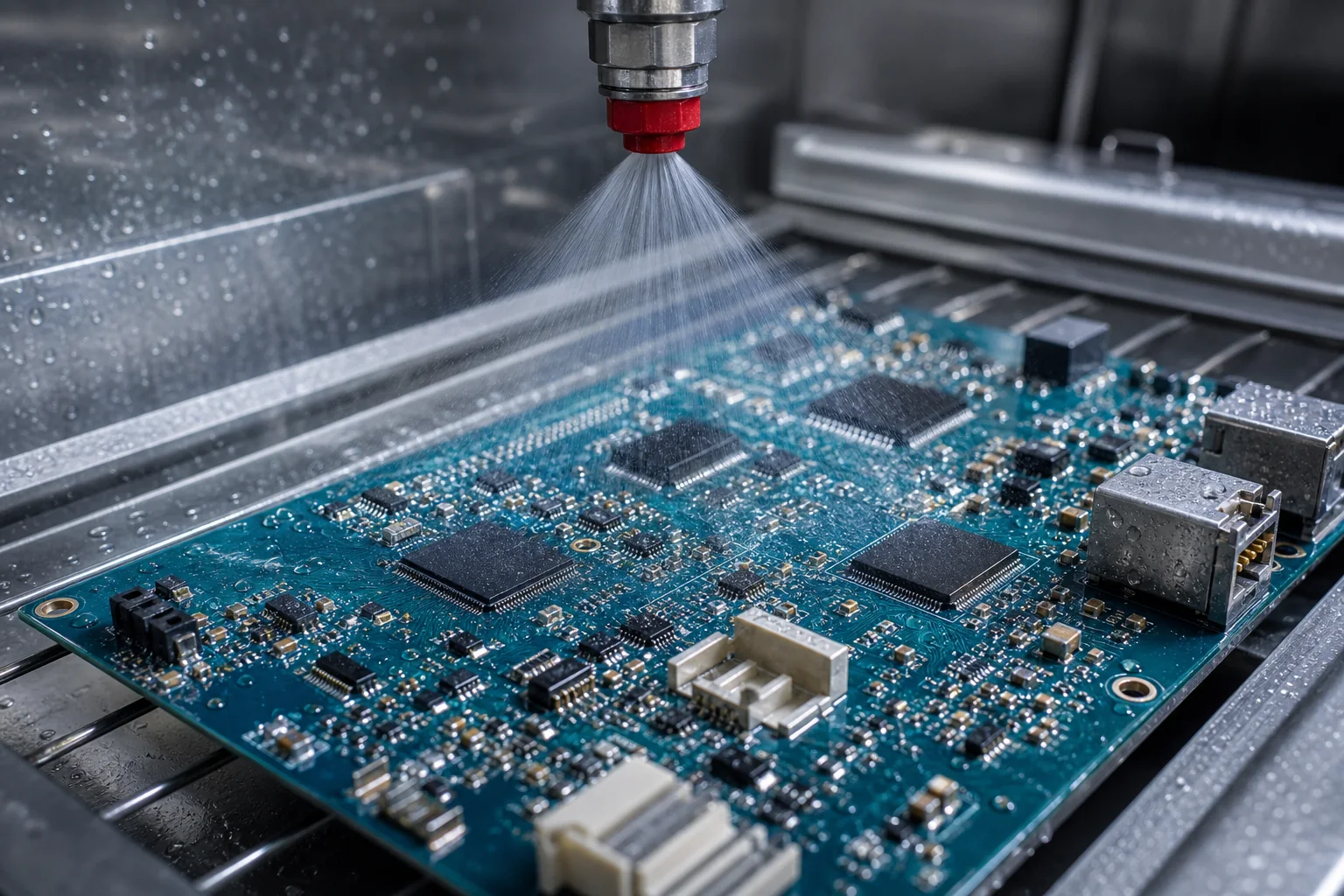
An inline PCBA cleaning machine is designed to integrate directly into automated SMT production lines, providing consistent and repeatable cleaning performance for high-volume manufacturing.
Compared with manual or batch cleaning methods, inline cleaning systems offer several advantages:
1. Consistent Cleaning Quality
Automated spray cleaning technology provides stable pressure, temperature, and process control, helping manufacturers maintain consistent cleanliness across large production volumes.
2. Multi-Stage Cleaning Process
Advanced cleaning systems typically include multiple process stages, such as:
- Pre-wash
- Chemical cleaning
- Chemical isolation
- DI water rinsing
- Final rinse
- Air blow
- Hot air drying
This combination helps remove different types of flux residues, including:
- Rosin flux
- No-clean flux
- Water-soluble flux
while minimizing the risk of contamination after cleaning.
Intelligent Monitoring Improves Process Stability
Modern electronics manufacturing requires greater visibility into production processes.
Advanced PCBA cleaning equipment can monitor key parameters such as:
- DI water resistivity
- Spray pressure
- Temperature stability
- Chemical concentration
- Drying performance
Real-time monitoring allows manufacturers to identify process variations earlier and maintain stable cleaning results.
This is especially important for industries where product reliability is critical, including:
- Automotive electronics
- Semiconductor packaging
- Medical electronics
- Industrial control systems
- Aerospace electronics
Improving Cleaning Efficiency and Reducing Consumption
Besides cleaning performance, manufacturers are also focusing on environmental impact and operating costs.
New-generation cleaning technologies optimize:
- Chemical circulation systems
- DI water usage
- Cleaning chamber design
- Heat management
For example, optimized double cleaning sections and chemical vapor condensation designs can help reduce chemical consumption while maintaining effective cleaning performance.
FC760 Inline PCBA Cleaning Machine: Designed for Advanced PCB Applications
The FC760 Inline PCBA Cleaning Machine is developed for high-density PCB assemblies requiring reliable flux removal and process control.
Key capabilities include:
- High-pressure spray cleaning technology
- Support for advanced packages such as uBGA, LGA, QFN, and QFP
- Multi-stage cleaning and drying process
- DI water quality monitoring system
- Intelligent PLC + industrial PC control
- SMEMA communication for SMT line integration
- Real-time process data monitoring
By combining cleaning performance, automation, and intelligent control, inline cleaning technology helps manufacturers meet increasingly strict cleanliness requirements.
Learn more:
https://pcbacleaner.com/product/fc760-inline-cleaning-machine/
Conclusion
As electronics continue to evolve toward higher density and higher reliability, PCBA cleaning is becoming an essential manufacturing process rather than an optional step.
A well-designed cleaning process helps manufacturers reduce contamination risks, improve product reliability, and achieve more stable production performance.
For companies producing advanced electronic assemblies, investing in reliable inline PCB cleaning technology can become an important part of building long-term manufacturing quality.