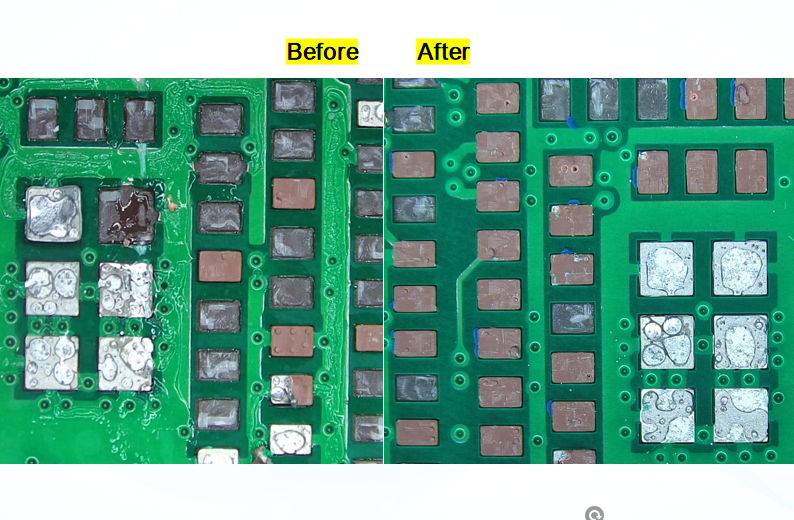
1. Test Equipment and Conditions
ACTSPRAY conducted cleaning tests on two representative samples using the FC760 inline cleaning machine to evaluate the removal of water-soluble flux and contaminants under different process conditions.
- Cleaning equipment: ACTSPRAY FC760 inline cleaning machine
- Compressed air supply pressure: 0.5 MPa
- Primary cleaning medium: Deionized (DI) water
- DI water spray pressure: 4 kgf/cm²
- Cleaning performance evaluation: Microscopic inspection for visible flux residues
- Test samples: Sample 1# and Sample 2#
The test program included multiple conveyor speeds and a separate evaluation using NS308 neutral semi-aqueous cleaning agent.
2. DI Water Spray Cleaning Results
Sample 1#: Cleaning at Three Conveyor Speeds
Sample 1# was tested using DI water at a spray pressure of 4 kgf/cm², with the compressed air supply maintained at 0.5 MPa.
| Parameter | Test condition |
|---|---|
| Cleaning medium | DI water |
| Spray pressure | 4 kgf/cm² |
| Compressed air supply pressure | 0.5 MPa |
| Conveyor speeds | 30, 40, 50 cm/min |
| Inspection method | Microscopic inspection |
| Result | 100% cleaning efficiency at all three settings |
| Observed flux residue | None detected by microscopic inspection |
All three tested conveyor speeds achieved complete removal of the targeted water-soluble flux and contaminants, with no flux residues observed during microscopic inspection.
Sample 2#: Low-Standoff LGA Cleaning at a 35 µm Gap
Sample 2# featured an LGA component measuring 18.7 × 16.5 mm, with an approximately 35 µm gap beneath the component. This sample was evaluated using DI water spray cleaning at five conveyor speed settings.
| Parameter | Test condition |
|---|---|
| Component type | LGA |
| Component dimensions | 18.7 × 16.5 mm |
| Approximate standoff gap | 35 µm |
| Cleaning medium | DI water |
| Spray pressure | 4 kgf/cm² |
| Compressed air supply pressure | 0.5 MPa |
| Conveyor speeds | 10, 20, 30, 40, 50 cm/min |
| Inspection method | Microscopic inspection |
| Result | 100% cleaning efficiency across all five settings |
| Observed flux residue | None detected, including beneath the LGA component |
Microscopic inspection confirmed that no flux residues were observed on the sample surface or beneath the tested LGA component across all five conveyor speed settings.
These results demonstrate the FC760’s ability to remove the targeted water-soluble flux under the tested conditions, including beneath an LGA component with an approximately 35 µm standoff gap.
Test Result Summary
Across both samples, the FC760 achieved 100% cleaning efficiency under the specified DI water spray cleaning conditions, based on microscopic inspection.
- Sample 1#: Three conveyor speeds tested — 30, 40, and 50 cm/min.
- Sample 2#: Five conveyor speeds tested — 10, 20, 30, 40, and 50 cm/min.
- Total: Eight DI water cleaning conditions evaluated, with no flux residues observed under microscopic inspection.
3. NS308 Neutral Semi-Aqueous Cleaning Agent Test
ACTSPRAY also evaluated NS308 neutral semi-aqueous cleaning agent on both samples.
| Parameter | Test condition |
|---|---|
| Cleaning agent | NS308 neutral semi-aqueous cleaning agent |
| Concentration | 18% |
| Spray pressure | 3 kgf/cm² |
| Conveyor speed | 30 cm/min |
| Samples | Sample 1# and Sample 2# |
| Inspection method | Microscopic inspection |
| Result | No flux residues observed on either sample |
No flux residues were observed on either sample under the specified NS308 test conditions.
This provides an additional process option for applications where a cleaning agent is required. The final cleaning chemistry should be selected according to flux compatibility, assembly materials, rinsing requirements, drying performance, and the customer’s cleanliness criteria.
4. Process Adjustment for Mass Production
For mass-production applications, FC760 process parameters can be adjusted to accommodate different assembly designs, flux chemistries, cleanliness requirements, and throughput targets.
Adjustable parameters include:
- Cleaning temperature: To suit the selected cleaning medium and flux chemistry.
- Conveyor speed: To balance cleaning performance and production throughput.
- Spray pressure: To achieve suitable spray action for the assembly.
- Air knife pressure: To support water removal before subsequent drying or downstream processing.
The final production recipe should be validated using representative assemblies under actual operating conditions.
5. Conclusion
The FC760 inline cleaning machine was evaluated using two samples under multiple DI water spray cleaning conditions, followed by a separate NS308 semi-aqueous cleaning agent test.
For DI water cleaning, both samples achieved 100% cleaning efficiency across all eight tested conveyor speed conditions, based on microscopic inspection, with no flux residues observed. Sample 2# specifically demonstrated flux removal beneath an LGA component measuring 18.7 × 16.5 mm with an approximately 35 µm standoff gap.
The NS308 evaluation also showed no observed flux residues on either sample at an 18% concentration, 3 kgf/cm² spray pressure, and 30 cm/min conveyor speed.
These results provide a practical reference for evaluating inline PCBA cleaning processes involving water-soluble flux and low-standoff components. Actual production performance should be confirmed against the customer’s cleanliness and process validation requirements.
Need to evaluate your PCBA cleaning process?
Contact ACTSPRAY to discuss your assembly design, flux type, target throughput, and cleaning requirements. Our team can help evaluate suitable inline cleaning configurations and process parameters for your application.