In semiconductor packaging, even microscopic contamination can become a concern for product reliability and manufacturing quality.
During a recent microscopic inspection of a semiconductor package before cleaning, an unusual phenomenon was observed around the gold wire bonding areas: thin, filament-like structures extending outward from the bonding points.
These structures were associated with flux residue, presenting a particular challenge for precision cleaning processes.
Unlike ordinary surface contamination, filament-like residues around delicate wire bonds require careful evaluation. Removing them effectively while protecting the integrity of the gold wires is an important consideration in semiconductor package cleaning.
1. What Does Filament-Like Flux Residue Look Like?
The following microscope image shows filament-like structures around gold wire bonding areas before cleaning.
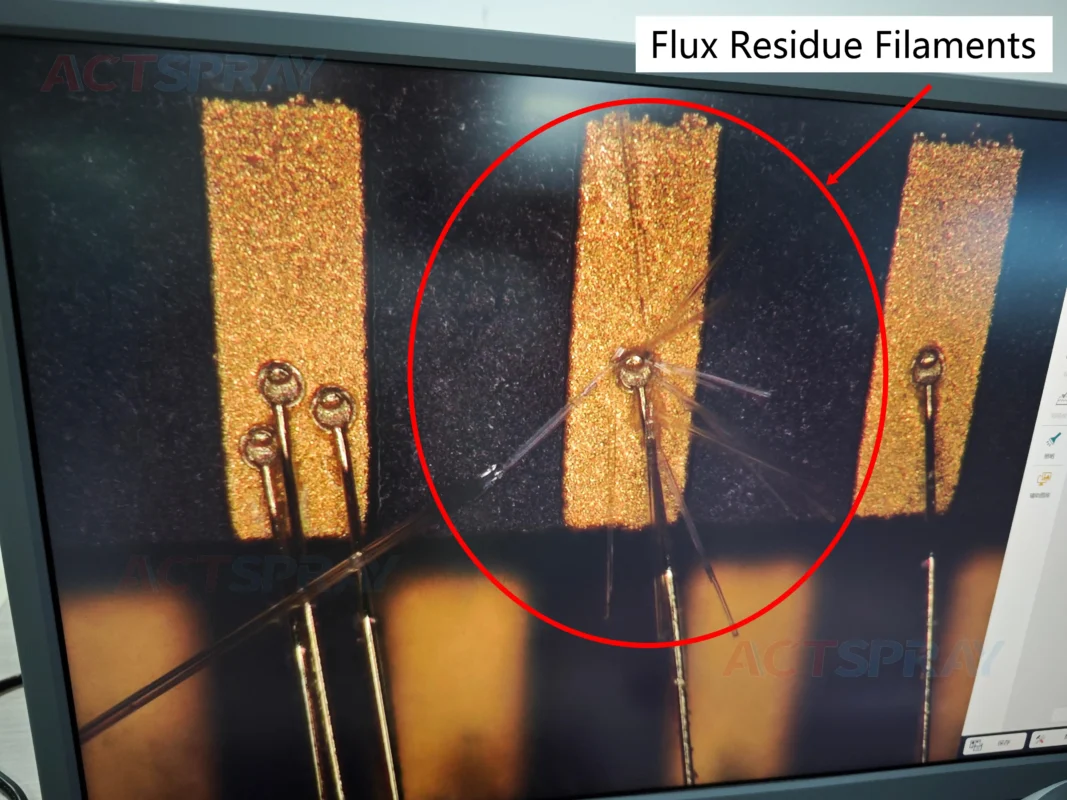
Figure 1. Microscopic observation of filament-like flux residue around gold wire bonds before cleaning.
The observed structures have several noticeable characteristics:
- Thin, elongated formations extending from the bonding area.
- Irregular, hair-like or filament-like appearances.
- Residue concentrated around the gold wire bonding points.
- Localized contamination near delicate metal interconnections.
This type of appearance should not automatically be classified as metal whiskers or gold whiskers. Further material analysis is necessary to determine the exact composition and formation mechanism.
When associated with flux contamination, these structures warrant investigation into the effects of soldering materials, thermal processing, and subsequent cleaning conditions.
2. Why Can Flux Residue Become Difficult to Remove?
Flux is commonly used during soldering and assembly processes to remove surface oxides and promote reliable solder connections.
However, some flux components can remain on the assembly after thermal processing.
Depending on the flux formulation and processing conditions, residual materials may undergo chemical changes during heating, including oxidation, polymerization, or cross-linking.
These changes can make certain residues more difficult to remove.
Several factors may contribute to stubborn flux contamination:
Flux formulation
Different flux systems contain different combinations of resins, activators, solvents, and other additives. Their cleaning requirements can vary significantly.
Thermal processing conditions
Reflow temperature, heating duration, and repeated thermal exposure can affect the physical and chemical properties of residual flux.
Residue location
Flux trapped around wire bonds, package edges, and narrow gaps may be more difficult to reach than contamination on exposed surfaces.
Time between soldering and cleaning
Depending on the flux chemistry and storage conditions, delayed cleaning may make certain residues more challenging to remove.
Understanding the actual flux composition is therefore an important first step in developing an effective cleaning process.
3. Why Is Cleaning Around Gold Wire Bonds So Challenging?
Gold wire bonding is widely used in semiconductor packaging to establish electrical connections between semiconductor dies and package substrates or leadframes.
These interconnections are extremely delicate.
During cleaning, the objective is not simply to remove visible contamination. The process must also protect the mechanical and electrical integrity of the wire bonds.
Three major challenges need to be considered.
3.1 Removing Residues from Small and Complex Areas
Flux residues can accumulate around bonding points and other geometrically restricted areas.
Cleaning equipment must provide sufficient access and effective cleaning action to remove contamination from these locations.
3.2 Avoiding Mechanical Damage to Gold Wires
Gold wires are delicate structures. Excessive mechanical impact, inappropriate spray pressure, or unsuitable cleaning conditions may cause wire deformation or damage.
Higher spray pressure does not necessarily mean better cleaning performance.
The cleaning process should be optimized according to wire diameter, bonding geometry, package structure, and contamination characteristics.
3.3 Achieving Effective Rinsing
Removing loosened flux residues is only part of the process.
The cleaning system must also provide effective rinsing to prevent dissolved or dispersed contaminants from redepositing on the package surface.
Water quality, rinsing flow, and drying conditions should all be considered during process development.
4. How to Develop a Suitable Cleaning Process for Semiconductor Packages
A reliable cleaning process should be established through actual sample testing rather than relying solely on standard machine parameters.
The following factors deserve particular attention.
| Process Parameter | Key Consideration |
|---|---|
| Cleaning chemistry | Compatibility with the specific flux formulation and package materials |
| Cleaning temperature | Sufficient cleaning effectiveness without affecting sensitive components |
| Spray pressure | Balanced cleaning action and wire bond protection |
| Nozzle configuration | Appropriate coverage of complex package structures |
| Cleaning time | Adequate contact time for residue removal |
| Rinsing quality | Effective removal of dissolved and loosened contaminants |
| Drying conditions | Complete drying without introducing thermal or mechanical stress |
For difficult flux residues, cleaning chemistry and mechanical cleaning action should be evaluated together.
Depending on the application, precision spray cleaning can provide a controlled alternative to more aggressive cleaning methods.
The final process should be validated through microscopic inspection, appropriate contamination testing, and electrical or functional verification where applicable.
5. Why Sample Testing Matters Before Selecting a Cleaning Machine
Different semiconductor packages have different structures, wire bonding arrangements, material combinations, and contamination characteristics.
A cleaning process that works well for one package may not be suitable for another.
Before selecting equipment, manufacturers should evaluate:
- Actual package dimensions and bonding structures.
- Flux type and contamination characteristics.
- Cleaning chemistry compatibility.
- Required cleaning and rinsing performance.
- Potential impact on gold wires and other sensitive components.
- Repeatability under production conditions.
At ACTSPRAY, we believe that cleaning equipment selection should be based on actual production requirements and sample validation.
Our precision spray cleaning solutions can be evaluated for semiconductor packaging, PCBA manufacturing, and other applications involving demanding contamination removal requirements.
6. Conclusion: Cleaning Performance Must Be Balanced with Wire Bond Protection
Filament-like flux residue around gold wire bonding areas highlights an important challenge in semiconductor package manufacturing.
The goal is not simply to achieve a visually clean surface. It is to remove stubborn contamination while maintaining the integrity of delicate interconnections.
A successful cleaning process requires the right combination of cleaning chemistry, temperature, spray conditions, rinsing, and process validation.
For semiconductor manufacturers, understanding the contamination before choosing the cleaning method is the first step toward a reliable cleaning solution.
Looking for a suitable cleaning process for semiconductor packages with delicate gold wire bonds?
Contact ACTSPRAY to discuss your application and arrange a sample cleaning evaluation.
About ACTSPRAY
ACTSPRAY develops and manufactures precision industrial cleaning equipment for PCBA, semiconductor packaging, and advanced electronic manufacturing applications. Our solutions include spray cleaning systems, batch cleaning machines, and supporting water treatment and recycling equipment.